Winter Construction - all kinds of added grief

With the huge dump of snow over the New Year holiday, our framer arrived back to the site to find the houses once again full of deep snow.  Now it is hard to clear out because the snow must be shovelled through the windows rather than pushed off the sides.

Two of the three main framers are off sick, either they didn't get their flu shots or it is something else related to the season.  I neglected to mention that if we were on schedule the second floor would have been on and the snow would have been easily brushed off rather than fill every possible crevice and stud space inside the main floor walls.

At my other site there has been an unexpected but welcome development, the Atco contractor has dropped off the ground heating unit.  This will thaw the ground enough so they can disconnect the gas line in the alley.  Once this gas line is done, we can have Atco sign off the disconnect and I can pull the demolition permit at City Hall.  I am not sure when I am going to proceed with the actual demo, it is a costly process to fence the site and dump the waste and without immediate plans to build on the site (no Development Permit) it isn't a job that needs rushed.

Winter construction definitely adds a layer of difficulty and often cost for the builder.  Since the winter season is so long in Calgary we must make the best of it.  At least it does not rain here in winter!


This looks to be a propane fired ground heater rigged to a trailer.  I have not seen this used before. I do remember in the 'old days' they used to dump a bunch of coal under a barrel cut in half and leave it to smoulder for days.  Avoidin…

This looks to be a propane fired ground heater rigged to a trailer.  I have not seen this used before. I do remember in the 'old days' they used to dump a bunch of coal under a barrel cut in half and leave it to smoulder for days.  Avoiding the toxic smell of that is a welcome improvement.  Hopefully they get it done quickly so the neighbour across the alley can get back in their garage.

Santa comes early for inner city land sellers

On this blog we have commented often that inner city land prices did not correct much during the depths of the horrible recession we are 'still' suffering through.  This may be because of ongoing scarcity but also because the builders, as a group, can't seem to exercise common sense when it comes to buying land.

With just a few signs of economic recovery since the Trump election, such as Liberal pipeline approvals (won't have any impact on the economy in the short term), OPEC deals to manage supply (notorious cheaters will do what they always do and pump even more), and an oil price scraping along over $50, the builders have rushed back into buying land at nosebleed pricing levels.  The surest way to undermine your building business is to overpay so much for land that you can't salvage any margin at the end.  

The builders must know something I don't about 2017, or they just have this inherent optimism that is necessary to engage in gambling on low margin spec home projects.  Land prices are now back almost to the heights of early 2014, yet the finished home market is much softer and will remain so until the job market and buyer confidence improves.  Sellers have been quick to cash in on their properties and the builders more than willing to big up the few available R2 properties.  This would have sold for $100k less only 8 months ago...


Christmas arrived on December 23 for this seller, as the land sold at $40k over the asking priced.  I felt the asking price was already too high... 

Christmas arrived on December 23 for this seller, as the land sold at $40k over the asking priced.  I felt the asking price was already too high... 

Quick service at Calgary City Hall

Builders are among the first to point out slow processes, costly fees and bureaucracy at City Hall. I've done this a few times on my blog already. What is also true is that some departments and functions work really well and the staff there do a good job and serve the taxpayer (me) promptly. 

My first example is the tax department. In order to get street parking passes for my 33 st job site I needed to show that I was the taxpayer of record. Once I identified the correct staff email address (can be a challenge) I had the new tax roll paperwork with proof of ownership in my inbox within a few hours.

My second example is the Calgary parking authority.  They regulate parking permits in the controlled areas. Residents get a pass to allow them to park in certain areas. As a land owner in the k1 zone I was possibly entitled to two visitor passes. These will allow me to park outside my job site  while I am doing the work to get it built.  I can be a visitor at my site, but I can't get a resident permit (there are a lot of rules related to this I don't claim to have scrutinized).  More than likely I will end up violating the parking restrictions so I need to retain some ability to plead ignorance.  Once I provided the correct paperwork to the staff they issued me the passes immediately and they arrived in the mail two days later (100% free of charge even!).   


A little paperwork and I can now park my truck in front of my threeplex project location.  The k1 zone controls who can park near the Westbrook train station (nobody can except residents).  

A little paperwork and I can now park my truck in front of my threeplex project location.  The k1 zone controls who can park near the Westbrook train station (nobody can except residents).  

My final example is the waterworks department.  I completed a service kill when I was installing my new sewer system at my duplex project. After submitting proof of completion to the staff they issued my $4250 refund in less than three weeks.  It is always a relief to get that fee back because the security payment is a real cash drain for builders with multiple demolition permits outstanding.  Hopefully one day the City will let builders with a track record of successful service kills avoid the security deposit, or at least allow one deposit to be used over multiple projects. I will tweet a photo of this cheque to the Mayor and ask him when we can stop swapping this cheque back and forth between us.  

The first of my two service kill refunds is now returned.  I have much better uses for these funds than sitting in the City Hall bank account, so I am very grateful the City staff process these refunds promptly.  

The first of my two service kill refunds is now returned.  I have much better uses for these funds than sitting in the City Hall bank account, so I am very grateful the City staff process these refunds promptly.  

There is a large amount of post permitting interaction between the house builder and the City staff, and it is always a relief when they respond quickly.  In another month I will have two townhouse projects in front of the planning department. I'm hopeful they can approve my applications as promptly as the parking, tax and waterworks departments did. 


Framing Progress #2

The framers are making good use of the chinook that ended the cold conditions and have started raising the first walls.  I like a four man crew on a duplex because both sides can be framed at the same time.  This seems to make it progress a lot faster.  The rear living area features a 10 foot ceiling and this tends to create a nicer feel for the key main floor spaces.  Ten foot ceilings make for stairs with many risers, so we are trying a different approach to this project where the main floor height increases to 10 from 9 foot at the stairwell.  We also dropped the foyer one step and this defines the rooms a little nicer and diminishes the tunnel like feel that infill houses can have.  We met our stair manufacturer on site and we are looking at some unique yet really practical ways to add some wow factor to the main floor stairs.  

By the end of the week the main floor walls should all be standing.  The next lumber package is the most expensive delivery because it includes the structure for the second floor.  The various cantilevers and beams mean we need substantially more material than the main floor structure.  The roof package is quite reasonable on these homes, since the trusses are mostly just 2x4 material cut and shaped at the factory.  The companies that make these roof packages are extremely efficient.  Lumber cost for these two homes is around $40k, far from the most significant component of a new house project today.  


The first walls go up at the duplex project. 

The first walls go up at the duplex project. 

Why I like my framing crew

I hired a high quality crew of framers for my duplex project. Two of the guys on the crew I have wanted to use in the past but they were always too busy.  They also tend to work on mansion type houses in the most expensive Calgary neighbourhoods.  This led me to assume their cost of framing would be beyond my budget. 

Once the recession hit they suddenly got a lot less busy and adjusted labour rates accordingly.  So the future owners of this project are going to be getting a very well framed house by great carpenters.  

One of the tasks they include on this project is screwing off the floors.  The floor sheets get nailed and glued as they are laid as this is the quickest and easiest way to finish a floor. Screwing the sheets on each 16 inch centred joist is a lot more work. It also takes a costly drill and expensive consumables in the form of screw clips. For this reason floor screwing has become an "upgrade" item and a cottage  industry of guys who just do floor screwing has developed, and they charge by the square foot. 

Opinions also vary as to when the floors should be screwed. Some say to do it after the house is Drywalled.  My framers disagree and do it immediately while the glue is still wet and the floor is unobstructed by walls. Right away is the easiest way to ensure every sheet gets the same amount of screws.  So not only will our buyers get a well framed house they should get one without squeeks that could form over time if the nails loosen as humidity changes (calgary is subject to many humidity swings each year).  

The first house I built for myself I screwed the floors down by hand using a cordless drill. It was a small house but it took forever and I enlisted my spouse help out with a second drill. It was really hard on the back and the knees.  If I can find that photo I will post it. Here are some shots of how it is done by pro framers. 


The first half of the floor is freshly laid and screwed.  

The first half of the floor is freshly laid and screwed.  

Here is the real reason floor screwing has become an upgrade. So framers can recoup the cost of the pricey tool and many screws that are consumed by each floor. 

Here is the real reason floor screwing has become an upgrade. So framers can recoup the cost of the pricey tool and many screws that are consumed by each floor. 

Framing begins

Finally some above ground work is underway at the semi detached project.  We lost a week due to some extremely cold weather but our framers are now on site and capping the main subfloor.  

It often seems at this stage of the project such a significant passage of time and effort has taken place that we are at the end, rather than the very beginning of a job.  Many of the next series of tasks is predictable and efficient compared to the launch of a new house project where weather and heavy equipment schedules need coordinated.

We will have enough lumber supplies delivered this week to get us through the holiday season and hopefully a framed house in another four weeks. 


The framers hard at work on a sunny winter afternoon  

The framers hard at work on a sunny winter afternoon  

Rowhouse comment period - now until Dec 22 2016

The planning department dropped off the placards at our 33 St. location advertising an open  period for submitting comments by email to the lead planner on the file.

Given the nasty cold conditions the frosty flip board may not be legible.  If a person would like to submit comments they can to jarred.friedman@calgary.ca.  Another option is to contact me via my comment page on this website, phone or email is also welcome.

There will be additional opportunity to comment beyond this initial phase.  I expect the development permitting phase to take a number of months, usually at least four, and there is not likely to be much progress until the holiday season is over.

Affordable smart devices

The relentless technological progress in the building industry creates some great products.  A classic example is the evolution of the thermostat over the past few years.  The first really good one to hit the market was the Nest, and this company was later bought by Google.  This disrupted the industry and all the other manufacturers are now competing with web enabled, easy to use smart thermostats.

Thanks to some damage by one of the kids, I had the chance to swap out my old style $25 on/off thermostat that runs my infloor heating system in the basement with a new smart thermostat by Honeywell, called the Lyric 5.  This was half the cost of buying another Nest unit.  I will compare this unit and see if I prefer it to the Nest for use in my upcoming houses, and see how well it deals with the slow to react slab heat system vs a furnace.  The cost of web enabled devices is certainly getting more attractive, and the benefit of being able to check on your house via a phone in winter when on vacation is major plus.

One area of cost that has not come down very much is the 'structured wiring' work for smart home features.  We recently had some shocking quotes for work on our upcoming houses.  There is no way that smart home wiring should cost 1/4 or more of the value of a complete new house electrical system install with panels, underground services, dimmer switches, finished light package labour, and dozens of pot lights.  Needless to say we wont be spending thousands on wires behind the wall when you can get some of the new wifi smart gadgets for less than $200, and more future smart devices will be introduced not even require wiring.

Another example is security system wiring. The wiring cost could be used for purchasing the equipment for a wireless system that does not require a home phone connection and comes complete with motion sensors and a door sensor plus low cost monitoring.  We will be trying this new wireless home security system on our next show home to see how well it would work for our future clients.

Here is a shot of our new and old thermostats.  Looks great and can save energy/add comfort to the house.  


Looks good and is easy to set up once installed.  Install, while DIY friendly, required a call to the manufacturer and resulted in a painful process of running a third wire to the old thermostat location to power the new unit.  If this had…

Looks good and is easy to set up once installed.  Install, while DIY friendly, required a call to the manufacturer and resulted in a painful process of running a third wire to the old thermostat location to power the new unit.  If this had failed we would have been calling one of our heating guys to come and help out.  Once powered up the unit quickly configured itself to the home network and iPhone app.  

Backfill - foundation construction phase is now complete.

Despite the extreme cold, our excavator had the heavy machinery back on site this morning.  The backfill wraps up the foundation stage of our project.  

The underground phase of a project has a certain element of risk and unpredictability. Contractor selection is essential here and we were fortunate to have picked all excellent operators. We appear to be right on budget as we move into the framing stage of our project.

Underground and utility or basement work may be the stage of building where the most money is spent yet the least amount of progress is visible. To date we have incurred significant cost to demolish, survey, dig, connect sewer, pour and prep the basement for backfill. Cost of work to date on site plus the design and permitting fees likely exceeds $75k at this point of the process. We will describe the costs of infill building in a future post. 

Here is what we have to show for our $75k. 


All the work done to date is now covered up.  The framing starts next week and this is a fun time to watch the project really start to come together.  

All the work done to date is now covered up.  The framing starts next week and this is a fun time to watch the project really start to come together.  

Row-house DP ready to submit tomorrow

We just received the latest, edited version of the preliminary drawings for our three unit row house project from our design shop, inertia. The plans are now at the stage where we are satisfied that we have come up with the best possible creative solutions to the design brief I prepared months ago.

The design brief is a big picture set of guidance for my design team to understand what it is I am trying to achieve with a project.  I have found it extremely helpful to prepare a design brief not just for the design team, but also for myself to formalize my internal objectives.  When starting with a blank property, the options of what to do can be overwhelming.  The design brief focuses the design team effort so their time can be best spent making the first concept as close as possible to executing my project goals.

In the case of our 33 st row house project, my design brief included specific instruction on how I wanted the entrances to each unit to be set up, how many bedrooms and bathrooms were needed, and demographic information on the type of end user I expect to occupy the houses.  Given the many constraints on site, the setbacks, height allowances, parking requirements, fire code issues, and other rules at play, we quickly developed a workable concept.  

The next phase of the process is an initial review by the City planning staff, and eventual circulation to the various parties that will provide feedback.  Over the coming months we will navigate the permitting process, and eventually the outcome will be an approved project.  This is perhaps the most innovative and interesting project I have launched in my inner city building career.  It will transform a derelict corner in a great community into an urban row house.  I am extremely grateful that Calgary Mayor and Council has granted me the zoning to pursue this development in Killarney.

Transit oriented development (TOD) is a walkable, mixed-use form of area development typically focused within a 600m radius of a transit station


Can We Stay on Schedule?

When it comes to the construction schedule, I believe it is possible to stay on schedule, even during the winter.  The weather at this time of year does conspire against the builder.  Cold, dark, snow and holidays play a major role to disrupt the momentum of progress on site.  I have put together a schedule, as I always do, up to the pre-board inspection phase.  This assists me with timing deliveries, booking the upcoming trades, and overall coordination of the many moving pieces that go into the inner city project.

Just last we we counted over 25 different tradespeople attending the site to do a variety of tasks, from sewer install, trucking concrete, all the way to spraying on foundation damp-proofing. This week, given the extreme deep freeze, we have a much less ambitious schedule.  We have just completed the weeping tile and gravel around the foundation, and passed the pre-backfill inspection. From here we will be actually backfilling, getting the temporary power pole set up and running some conduit for later use as connecting the house and garage with underground power.  Next week, if all goes well, we can begin the framing.

Here is a sample of the construction schedule.  I like to have a Gantt style chart to make it easy to avoid booking jobs before the site is ready.   This is far better than a spreadsheet because it allows the builder to navigate multiple tasks at the same time, and it has a good phone app.  Without this type of schedule software the likelihood of making a costly mistake is increased.  


The schedule software allows tasks to be arranged in such a way that a single lost day won't cause a domino effect on the rest of the schedule.  Without this the site can become very chaotic.

The schedule software allows tasks to be arranged in such a way that a single lost day won't cause a domino effect on the rest of the schedule.  Without this the site can become very chaotic.

Asbestos roulette - how much will we lose this time?

The occupant of the 33 st property we bought, rezoned to multi-family, and are about to submit a three unit row house project for recently vacated.  Seems to be a great time to get the demolition sorted out.  Step one was get the demo permit paperwork and service disconnects submitted at City hall.

Step two is the asbestos sampling.  This is where luck plays a major role.  The sampling crew stopped by and we had a good look at the house.  Good news is the attic only had a layer of sawdust covered with pink insulation.  No problem there.  Most of the flooring was wood or newer linoleum, again that is harmless for disposal.  The lab work will now determine what is actually going to have to be remediated.  The usual culprit is drywall compound, and this leads to quite a nasty remediation bill.  We will know in a week or so the outcome of the survey.


Many samples were taken during the asbestos survey.  The lab analysis will determine the cost of remediation (if any).

Many samples were taken during the asbestos survey.  The lab analysis will determine the cost of remediation (if any).

Foundation damp-proofing

Once again the speed of our cribbers pays off in terms of staying just ahead of the weather allowing us to schedule and complete work that needs mild conditions to proceed.  Earlier delays cost us a few weeks of good weather, but the production of our crews has got us back on track, and with -20 C weather likely in the forecast we finished the spray on damp proofing just in time

The first step of the damp proofing involves caulking the tie holes that bind the forms together.  This is a nasty black goo that is squeezed out of a gun and into each tie.  


Each of the tie holes is filled first with the black compound.  It remain flexible over time and prevents water from penetrating the basement walls.

Each of the tie holes is filled first with the black compound.  It remain flexible over time and prevents water from penetrating the basement walls.

This is a two man crew, the first does the tie hole filling, the second does the spray work

This is a two man crew, the first does the tie hole filling, the second does the spray work

With the tie holes all filled, the spray applicator gets on his suit and face mask and fires up the compressor in the cube van.  Spraying the entire basement will not take very long.


The first pass is at the joint between the footing and wall.  This is a key area and gets a generous coat

The first pass is at the joint between the footing and wall.  This is a key area and gets a generous coat

Our operator has 25 years of experience damp proofing foundations.  Here he is coating the walls in 6-8 inch passes.

Our operator has 25 years of experience damp proofing foundations.  Here he is coating the walls in 6-8 inch passes.

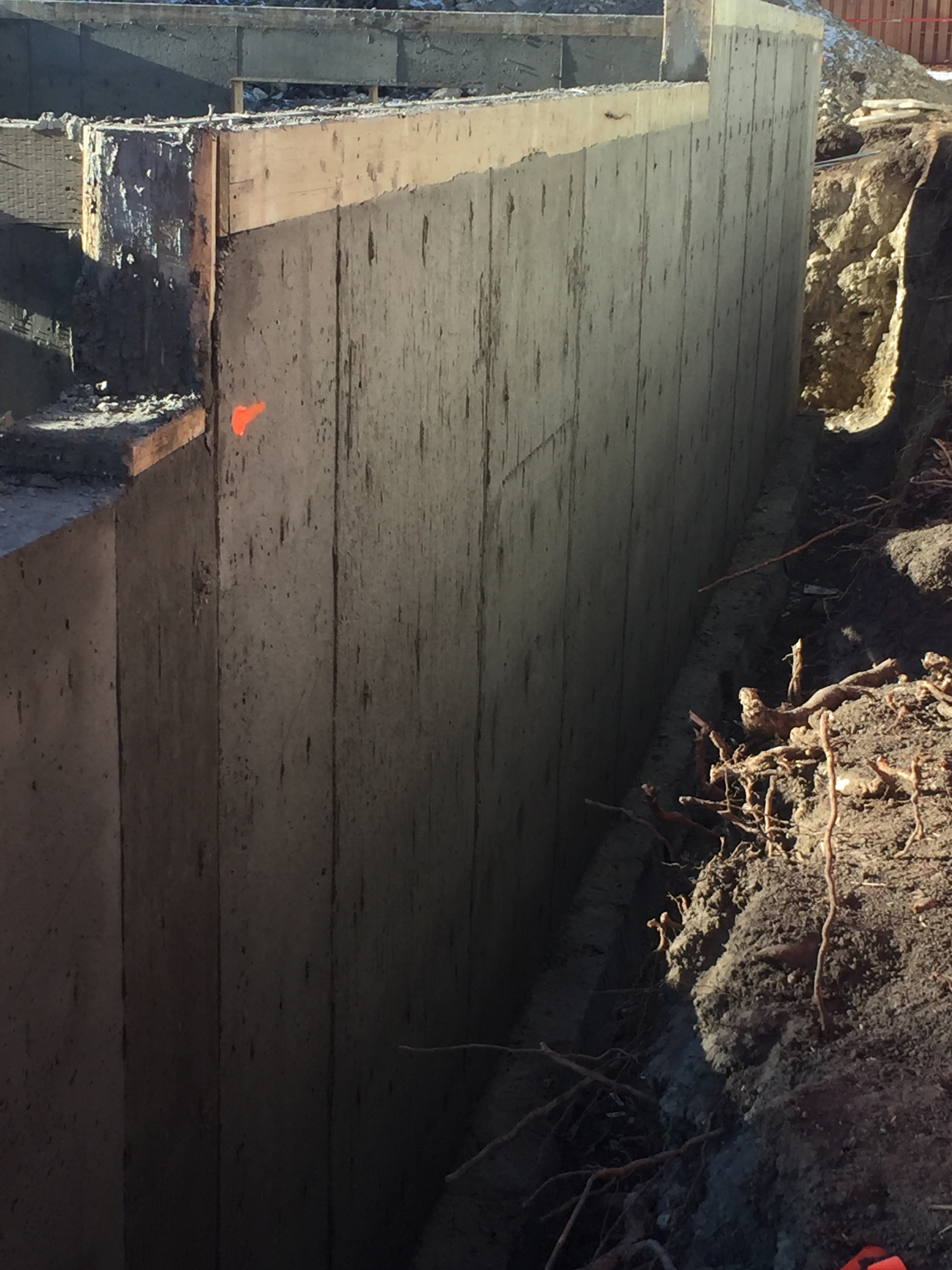
Note the orange spray mark near the top of the wall.  Grades have been marked  on all corners by yours truly. Staying one step ahead of the guys is a constant challenge for the active site manager.

Note the orange spray mark near the top of the wall.  Grades have been marked  on all corners by yours truly. Staying one step ahead of the guys is a constant challenge for the active site manager.

And the shiny black coat goes on and the job is done.  The spray work can't be done in very cold conditions, fortunately we have been blessed with a very mild early winter.  We have a few jobs left to do and we can backfill this basemen an…

And the shiny black coat goes on and the job is done.  The spray work can't be done in very cold conditions, fortunately we have been blessed with a very mild early winter.  We have a few jobs left to do and we can backfill this basemen and start working above the ground.

Unsung heroes of construction - the form strippers

From strippers are some of the hardest working and most under appreciated labourers in the construction business today.  Of all the unpleasantness that goes into building a house, form stripping is among the nastiest, hardest, most repetitive and overall toughest jobs a person can have.  

A typical suburban bred, desk dwelling softie would be unlikely to survive a single shift of form stripping.  For this reason alone, we should salute the form strippers, without them the foundation business would not be the efficient machine it is today.  Keep in mind we started from an empty hole in the ground on tuesday, and by saturday all the forms were peeled off and stacked back on the trailer.  

The job is remarkably simple.  Strip the bracing and forms off a newly poured basement, haul the heavy, moisture laden, filthy 9 ft sheets of plywood out of the excavated area up a slippery ramp and drop on the trailer. Do this 100 more times inside and out of the basement and the job is done.  Drive on to the next basement and do it all over again.  Thanks again form strippers for getting our basement done on a saturday morning.  Here is a series of photos showing the essence of form stripping.


Cribbing part 2 - the rebar, bracing and pour - busy week in review

Our cribbers finished the job quickly and were already finished by lunch, as they are racing the weather and trying to get another couple jobs done.  Our project engineer arrived to site at 8:30 in the morning and had the inspection complete, giving the go ahead for pouring later that afternoon.

We will show a series of photos below describing the final stages of the cribbing project.  Note that we were able to get our pour done in above freezing conditions.  The sand and water components of the mix are heated at the plant, so the mix arrives able to set up properly in cooler weather.  There is a large cost to the winter heat included in the price of the concrete, but it is worth the investment ensure a good pour.

This week activity has been constant on site.  We went from basically an empty, surveyed hole in the ground to having the sewer installed, the basement cribbed, inspected and poured, and tomorrow we will have the forms stripped and the walls damp proofed.  During the week we also successfully applied for a demolition permit for our next project, set up all the service disconnets so the house can be demolished, arranged an asbestos test for the weekend, reviewed the plans for our three unit townhouse and sent feedback to the design team, and salvaged/sold some appliances from the old house on site.  We also arranged a deal to swap out our construction truck for a new model, trained a novice builder friend how to get a demolition permit for his first project, and attended parent teacher interviews for both kids.  We spent a significant portion of our construction budget, approximately $40,000 of invoices will be paid based on the work week. We will provide an update on expenditures to date in a future post.  That is all for now.      


Here the bottom two rows of rebar are shown installed on top of the bottom row of ties, and near the centre of wall.  This provides significant strength advantages to the wall  

Here the bottom two rows of rebar are shown installed on top of the bottom row of ties, and near the centre of wall.  This provides significant strength advantages to the wall  

At this point, the cribbing is complete.  The walls are braced and the forms approved for concrete placement.  

At this point, the cribbing is complete.  The walls are braced and the forms approved for concrete placement.  

The pump truck is positioned and set up, and the first mixing truck has arrived.  The capacity of the pump is enormous and it can fill the forms for these two homes in an hour, provided enough trucks are on site to keep the hopper full.  

The pump truck is positioned and set up, and the first mixing truck has arrived.  The capacity of the pump is enormous and it can fill the forms for these two homes in an hour, provided enough trucks are on site to keep the hopper full.  

At this point the concrete is placed and the walls are drying.  These are 8 ft forms, generally we use 9 ft forms, but given the height constraints on site we dropped the basement ceiling to 8 ft. Fortunately the weather is above freezing so th…

At this point the concrete is placed and the walls are drying.  These are 8 ft forms, generally we use 9 ft forms, but given the height constraints on site we dropped the basement ceiling to 8 ft. Fortunately the weather is above freezing so the walls can properly set up.

Cribbing Part 1

The crew started yesterday cribbing the basement walls. They put the insides up first, pass ties through the slits in the boards, and build a wood box around the top called the ladders.  

A series of rows of rebar are added to the walls, then the outside walls are raised.  Finally vertical rebar is added and the walls are braced for the pour.  

This is a fast and hardworking crew. They can get a basement set up in a day or two. They ordered the pour already and the engineer has stopped by to give his ok. We will visit the site later today and take a few shots of the cribbing.  Here is a view from yesterday afternoon.  


Interior walls, ladders and ties are installed.  

Interior walls, ladders and ties are installed.  

How to efficiently get a demolition permit - update 1

UPDATE 2022 - this process described below is quite outdated, thanks in large part to the CICBA and internal city procedures are improved. Not much point in reviewing this post as shown below, despite this post attracting repeated web traffic.

UPDATE 2018 July - this post is now out of date, the City has created an online permit application system for the demolition permit.  While much of the process of collecting signatures for the utility shut offs remains the same, most of the work can now be done without going to City Hall.  This is a major improvement and saves the builder a lot of time and money!

We recently posted a lengthy entry on how to get a demo permit in Calgary. One of the key findings was that three trips to City hall and the endless paperwork seems to be a little too much effort just to get permission to bulldoze your own property.  There must be a better way to get a demo permit in Calgary.  We have explored various techniques to reduce the effort necessary to get the permit, and the commentary below is the outcome of our journey.

Since I applied for a demo permit just a few weeks ago, the lengthy process is quite fresh in my memory. I improved the process somewhat to eliminate one of the two preliminary City hall visits for my new demo application. What you have to do is email the water department to get a service kill quote before you take any other action. Since the service kill quote is always $4250 the staff is quick to reply with your quote. I did this Monday night before midnight and had a reply at 7 am Tuesday.  Why you need to get a service kill quote when the estimate is always the same $4250 is just another peculiarity of dealing with City hall.  Even more frustrating is it does not cost $4250 to do a service kill.  I am waiting for the day when I get a service kill quote for $4250, and then get a quote to do the kill for $4251.  Under that scenario I won't do the service kill and let the City deal with it themselves.  

Back to my new and improved demo permit strategy.  With the service kill quote and cheque prepared and in your back pocket, the applicant then can proceed to the 3rd floor application counter with the actual demo permit paperwork. This includes the demo fee, asbestos  document (completely pointless because you don't need asbestos clearance until later), tree report, colour photos, and two copies of the survey (rpr works great here), and the name of your demo contractor (if you don't have a contractor, don't let this stop you, just make up a name and use that, and change it later. The key with this demo permit process is to keep it moving, not get bogged down in the detail). 

Upon successful submission of the demo permit paperwork, the service disconnect worksheet is printed at the permit counter and given to you.  You can now pay the $4250 (different payment window - no logic here for another line and payment window because you just paid for the demo permit on your credit card at the permit counter, this is yet another peculiarity of dealing with City hall).

Having completed the paperwork stage, you can now call 311 and request a water meter removal appointment. This will go into the system as soon as the $4250 is processed. The City will call you in a couple days to arrange an appointment to shut off the water.  Most time the response of 'the City will call you to book an appointment' is a frightening concept to the home builder.  Possibly the City may not decide to call you for months.  Rest assured this department is pretty quick to call you, generally we only wait 2 business days max for the appointment to be arranged.

The next call you can make is to Enmax to request a permanent electrical disconnect.  As with any abandoned house you will have to create an electrical account in order to cancel the service.  

(side note 1 - given the strong likelihood that your tenant abandoned ship without paying the utilities, the electricity is likely now shut off by enmax.  Once you take over the account the power will turn on, and this may light up the entire house in the middle of the night, and cause the neighbour to call the police to say that someone is breaking into the house.  You will have to go to the house turn down the furnace - currently set at full blast, close the fridge doors and turn off all the lights, hopefully you have a functional key or this will be a fruitless exercise.  Yes this happened to us and no we did not have a key that opened the door.)

(Side note 2 - when you buy a house with suspect provenance, you should try the key you are provided with to determine that it works.  We have bought multiple houses without the proper key being provided.  Since you are unlikely to collect any rent from the tenants anyway, you may want to have vacant possession an condition of sale).  

Creation of an Enmax account can be a lengthy process unto itself, possibly requiring a cash deposit upfront (no doubt Enmax is constantly being scammed, so it is wary of initiating new accounts to suspicious characters like home builders).  This is typically a lengthy process but there is a workaround.  I always keep an Enmax business account current because the process is way faster if you are in the business stream (shorter hold times) rather than the residential retail stream on the phone system.  If you have a business account, Enmax will create an new electicity account for you right away, and also put in place the process to cancel the account you just created.  This may not sound sensible to you, but this will save considerable time when pursuing the electrical disconnect by being a business customer.  The business customer also can opt into a variable rate bill.

(Side note 3 - Enmax has changed its account offering to no longer offer a residential customer a variable rate electricity bill.  Why have they done this?  Well, the variable rate is about 1.5 c/kWh, whereas the residential fixed rate is 3-4x higher.  Go with the variable rate every time by being a business customer).

On the way back from City hall you can drive to the far northwest and visit atco to do the gas meter removal application. This application is  seemingly impossible to do on line (I did try once and failed, the best practice is to drive up north and take the last exit before the ring road to the atco office and get the form at the front desk). Atco is a private enterprise, so it has an entirely unique process for service disconnection.  None of this information is important to you, just get the paper filled out and handed in and you are in good shape for the gas disconnect.  Remember, the gas disconnect involves digging up the alley and exposing the high pressure gas main, not something that can be screwed around with by anyone except Atco trained crews.

(Side note 4 - Atco is building a massive new office complex near Currie Barracks on Crowchild and Glenmore.  This office will be within cycling distance - next time we need a gas disconnect we will attempt to bike to the office and will report back on how easy this can be done).

This demo permit application technique gets all the paperwork done in one intensive morning of minimized effort and aggravation. Now you can wait for all the issuing authorities to make the appointments for disconnect and do your asbestos sampling during this interim period.  The asbestos removal racket is likely the subject of an entirely long blog diatribe.  You would be safe to assume I have some opinions on the asbestos game that is played in Calgary. Here is one interesting piece of asbestos removal racket trivia - what days of the week do provincial asbestos inspectors work, and what days (i.e. Saturday/Sunday) are asbestos inspectors off duty?

The permit issuance phase - If you are lucky there will be no asbestos and you can return to city hall with the signed off disconnect sheet and pick up the demo permit. Keep in mind atco is taking five weeks to remove gas connections so you must do this well in advance of when you want to start the demo job. 

Hopefully this improved set of instructions saves someone the headache of repetitive trips to City hall that don't accomplish much.  We don't have another demolition permit to do for another year at least. Time to focus on building again rather than demolition. 

(Side note 5 - more than likely your neighbours are going to be pleased that the house is going to be demolished - try and use this goodwill to buffer you against the turmoil created by the eventual reconstruction of the new housing you will be building).

Concrete Pour Technology - New Equipment

Our new supplier, Tanas Concrete, brought its latest and brand new piece of equipment to site.  The machine finally resolves the eternal problem of ordering large amounts of concrete, that is how to get the volume ordered precisely right.

Ordering too little is a major headache, especially if a continuous pour is specified in a job like a basement.  Ordering too much leaves a disposal problem, as nobody wants a giant dump of concrete left on their front yard.  

The new Tanas truck mixes the sand/water/gravel components on site, this means they can shut the mixer off when the job is done and drive away with all the dry ingredients ready for use at the next job.  The idea behind this truck seems to be that it can rove around the various pours and finish the last bit of pouring at each job.  This means there will never need to be a half empty truck hauling back an unneeded wet load of wasted concrete back to the plant.  Over time, having the exact right amount of material delivered to every job is quite likely a huge money saver. We have a cellphone video of the truck in action, however this website only allows still photos and youtube videos.  Here are some shots of the truck in action


This is the control panel for the truck, have not seen a digital display on a concrete mixer before today

This is the control panel for the truck, have not seen a digital display on a concrete mixer before today

While this isn't the clearest image, you can see the sand and gravel are on a conveyer belt, these are combined at the end of the truck with water which is then sent to the pump truck for placing in the forms.  This truck eliminates any human l…

While this isn't the clearest image, you can see the sand and gravel are on a conveyer belt, these are combined at the end of the truck with water which is then sent to the pump truck for placing in the forms.  This truck eliminates any human labour from the arduous task of mixing concrete.  Unfortunately this type of machine is only to be found on bigger jobs.  Fence and deck builders will still have to mix their own batch.

This is the site mixing truck in action. Note the water supply vessel behind the cab.  This truck looks pretty similar to what you would find at a large batch plant at any commercial scale mixing location, just compressed enough to fit on a tru…

This is the site mixing truck in action. Note the water supply vessel behind the cab.  This truck looks pretty similar to what you would find at a large batch plant at any commercial scale mixing location, just compressed enough to fit on a truck body.  This must have been a significant investment by Tanas, but saves a lot of wasted concrete and eliminates the human error factor from poorly measured loads.

Basement Development - The key components of a successful basement project

Developing an inner city basement has a number of elements that must be carefully orchestrated into the finished product; 

  • the hole has to get dug in the right spot, so the surveyor is essential before work begins  
  • the excavator must get the hole level and at the proper depth at the bottom of the footing
  • the engineer must take the sample for soil bearing and sulphate content of the soil, this will impact concrete selection later (the mix is variable depending on the project requirements)
  • the engineer must already have developed plans for the footing rebar detail and thickness, and wall rebar pattern. This is variable based on soil bearing, depth of backfill, and the weight of the structure above
  • the lumber yard supplies the package necessary for the work, usually lumber, stakes, weeping tile and rebar
  • the cribbing crew sets the footing forms in place 
  • concrete placing crew, pump truck and mix trucks are now called upon to pour the footing
  • the cribbing crew arrives back on site to set the forms and rebar
  • the engineer usually requires a site visit at this point to inspect the foundation wall detail
  • the same concrete placing crew returns to pour the basement
  • a form stripping crew is usually brought in to peel off the forms and load the trailer
  • waterproofing is applied to the basement walls
  • gravel and weeping tile is delivered to site and installed 
  • the city is called in for a pre-back fill inspection
  • the excavator returns to backfill the basement
  • to add another step, at some point the sewer and water lines can be brought in, in our opinion the sooner the better for this specialized task.  

Our semi detached project is currently midway through the process, with the footing having been poured today. Let's hope our cribbing crew can get the walls up right away.  Here are some photos of the footing stage of the basement project with captions to provide further detail on what is happening.

This is the centre form that divides the two buildings, it is both wider, at 30 inches, and deeper, at 10 inches than the typical perimeter forms.  The middle footing also receives five rows of 10 mm rebar. the perimeter footing will receive on…

This is the centre form that divides the two buildings, it is both wider, at 30 inches, and deeper, at 10 inches than the typical perimeter forms.  The middle footing also receives five rows of 10 mm rebar. the perimeter footing will receive only three rows.

The cribbing crew is beginning the rebar install in the footing forms.  

The cribbing crew is beginning the rebar install in the footing forms.  

the rebar is hung approximately in the centre of the form, it must be at 2 inches from the edge of the concrete, this offers some protection of the rebar from rust

the rebar is hung approximately in the centre of the form, it must be at 2 inches from the edge of the concrete, this offers some protection of the rebar from rust

The pump truck and placing crew arrives, and less than an hour later the concrete is poured.  This job used about 10 cubic metres of concrete.

The pump truck and placing crew arrives, and less than an hour later the concrete is poured.  This job used about 10 cubic metres of concrete.

Inner City Sewer Install - What does a potential homeowner or builder need to know

Sewer install is quite literally one of the most important features of a new home and should be a great comfort to the new owner than they will be getting a brand new system connected to an existing 50-70 year old piece of City infrastructure.  A terrifying mess will be a guaranteed outcome if this work is done poorly.  

Due to the sensitive nature of the work, involving shutting down streets and digging up the City owned roads and sidewalks, only indemnified contractors can do this work.  The work is a real technical specialty, and the handful of indemnified crews have all the big toys to go along with this massive and time sensitive undertaking.


This brand new excavator was recently purchased by the owners at Precision Underground, at a cost of $190,000.  This purchase was motivated by the failed $10,000 turbo unit in the old machine, and the pressure to install 170 sewer systems per s…

This brand new excavator was recently purchased by the owners at Precision Underground, at a cost of $190,000.  This purchase was motivated by the failed $10,000 turbo unit in the old machine, and the pressure to install 170 sewer systems per season means down time is not acceptable.

In addition to the costly gear, the indemnified crews have a certain amount of pricing power over any client that needs the work done.  During a 'boom' year, expect to pay a significant premium for this work.  We have had the pleasure of hiring Precision Underground Services for the last few jobs we have done, one of the best indemnified crews doing this work in Canada.  

To complete the job, a significant amount of work needs to be done in advance by the builder.  This all comes at great cost as you will soon see.  

1.  Get a grade slip and hire the crew - the grade slip is provided once a DP is submitted to the city.  The grade slip provides the information that is used to quote the job (depth of sewer).  You can do some advance scouting here but basically you are at the mercy here of what the grade slip says.  The job can be quoted now, this time we did not bother getting multiple bids (will explain why later).

2. Pay the asphalt degradation fee - this will cost between $1900 and $6000.  We got off lucky this time because we are digging in an old road that hasn't been repaved recently.   Our next job we are not so lucky...

3.  Pay the $4250 water shutoff fee. This is the good news, you can get this back by doing the service kill, (which we have now done today - great for us to get that deposit back because we have another to pay soon).

4.  Demolish the site and dig the basement.  Pouring the basement and building the house may be necessary here if the indemnified crew can't get to you right away (often these crews have a multi month backlog).  

5.  We chose to go ahead with the install before pouring our basement because the winter season is upon us and sewer work largely shuts down.  Cutting through frost is very difficult as well as properly repairing the road.  This proved to be extremely beneficial.  By opening up the street we found that the sewer was just deep enough to allow us to gravity drain the basement plumbing, saving $2500 plus major aggravation on site.  Using the standard technique, the sewer would have been stubbed out to the property line and connected later, and lack of detailed measurements would have necessitated a higher pipe and lift stations.

6. Work is done following a similar methodology which is shown in the photos below


dig up the street and kill the old service for the sanitary water.  This was being done as we arrived to the job site.  Fortunately this crew starts work while builders are still in bed

dig up the street and kill the old service for the sanitary water.  This was being done as we arrived to the job site.  Fortunately this crew starts work while builders are still in bed

Next the street is trenched for the new water lines to be run to the basement of the house.  The lines are 1 inch pex pipe and must be 2.3 M deep to avoid frost issue.  


Note the shoring boards are used to prevent cave ins while trenching.  The crew has a genius system where the bracing pipes are charged with compressed air and quickly create a safe work zone.  the lower of the two braces is removed once a…

Note the shoring boards are used to prevent cave ins while trenching.  The crew has a genius system where the bracing pipes are charged with compressed air and quickly create a safe work zone.  the lower of the two braces is removed once a bed of gravel is laid to bed the new lines.

Once the trench is prepared the water lines go in.  


The vertical pipes show the water shutoff valves.  These are barely visible at the back of the frame.  

The vertical pipes show the water shutoff valves.  These are barely visible at the back of the frame.  

More gravel is added and the sewer pipes are laid according to the proper slope of 3 inch per length of pipe.


At this point the City inspector will be called to make sure the work is going according to the many rules of how this job must be done.  Not surprisingly, the work is passed quickly.  

At this point the City inspector will be called to make sure the work is going according to the many rules of how this job must be done.  Not surprisingly, the work is passed quickly.  

The trench can be partly backfilled at this point.  The trench must be compacted as it is filled, and of course the best tool for the job is the 'hoe pack'. The machine is so powerful the reverberations of the tool can be felt much like an earthquake for a wide area around the operator.  The machine is also able to span the trench to allow it to fill the trench and compact it quickly. The operator is highly skilled and crosses the trench repeatedly and can change tools at the end of the arm of the machine - hands free.


This excavator must carefully expose the City water and sewer mains, not damage them while doing so, and remove enough material that the remainder is easily hand dug.  The work is efficiently staged such that one pipe is being exposed while the…

This excavator must carefully expose the City water and sewer mains, not damage them while doing so, and remove enough material that the remainder is easily hand dug.  The work is efficiently staged such that one pipe is being exposed while the other is being covered.  All of this is happening in a manner that makes it look easy, but we are pretty confidant this is not at all easy, particularly in the way it is done and the pace of completion.

At the far end of the trench the water lines, already bedded in much of the trench, are connected using a wet connect tap to the City main, that remains pressurized at all times.  


This tool is used to tap into the City water main.  After connecting the water lines, the service is now completely live, and can be covered.

This tool is used to tap into the City water main.  After connecting the water lines, the service is now completely live, and can be covered.

The operator is using the hoe pack to compact the fill material and prepare the road for asphalt.  

The operator is using the hoe pack to compact the fill material and prepare the road for asphalt.  

This has been a brief overview of the install process.  There is much more detail to go over but this post is lengthy enough already.  This is about the least DIY friendly activity in construction today, but the site manager still has a role to play in making sure the work is done well and the outcome is what was agreed to in the contract.  The last role of the site manager is to hand over payment for the work.  The job tends to cost between $15,000 and $30,000 depending on the site condition and complexity of the install.  We got off pretty easy this time with a bill well under the $20,000 level.  Thanks again to Precision Underground for the fine job.