Active Site Management = Serious Job Site Savings

The benefit of having an aware, motivated, and empowered manager on site during key moments of construction cannot be overstated.  My definition of an active site manager, is someone who knows what needs to be done, is empowered to react to opportunities, and is rewarded from best practices.

On my sites, this person, being me, is supremely aware of how easily mistakes happen and how costly these mistakes can be.  Maintaining a state of eternal readiness to act, while mentally tiring, can lead to major unexpected site savings, as today's case study will describe.

No More Sewer Lift Stations

Having identified the job site as a shallow service location, we budgeted an additional $2500, plus significant inconvenience factor for install of sewer lift stations.  What this means is the basement floor is lower than the City sewer main, so cannot drain by gravity.  The basement level, usually having a wet bar, bathroom and furnace floor drain can generate substantial waste water, this must be contained in a large sump basin, and pumped upward into the City sewer main.  Over time this a possible maintenance and failure point, wastes space, makes noise, needs professional plumbing skills to have done properly and costs a lot of money.  There is not a single beneficial feature of the sewer lift station compared to standard gravity drainage.

However, once our crew dug up the street and compared the height of the City sewer main to our surveyed top of footing mark, it became clear that, with standard slope, we could slide the sewer pipe just under our footing.  This is where having the boss on site made the difference. The contractor was hired to bring the sewer lines just to the edge of the excavation and cap them there.  The sewer would be brought into the house by coring a four inch hole through the concrete wall of the basement (which does not yet exist) where it would then be connected much later by the plumber to the lift station.  Having identified the potential to bring the sewer lines into the building itself, I was able to get the contractor to add a length of pipe to each of the drain lines by trenching through the hard ground of the bottom of our excavation, and then bed the pipes in a scoop of gravel.  All this material and machinery was on site, for no extra cost.  

In a more passively managed project, the absentee builder would have hired the crew to do the service work and showed up after the job was complete to pay the bill.  At this point the opportunity to extend the sewer beneath the footing would have been lost.  The builder would have spent little to no time on actually managing the project (this is what builders like) and the cost would have been to the client of a $2500 expense plus having to live permanently without gravity drainage of the basement plumbing, and future maintenance liability.  Passive management is how inner city construction tends to happen.  This is because the investment side of the building company is detached (does not attend sites often) from the site management staff.  The link between a motivated and rewarded site manager is lost as soon as the site manager is not in an ownership position.  In a passively managed build, the owner would not have been aware of the significant site saving opportunity that presented itself for just a brief (2-3 hour) window that could only have been capitalized on by an aware manager empowered to make an instant decision.    

Our next blog post will show the actual service installation and describe some of the cost involved for the typical inner city project.  


Buying Land - Everything you need to know (is not in the realtor listing)

A nice land prospect popped up on the MLS this morning.  At first glance, it all looked good, in fact it could be great.  According to the listing agent, the property located at 2220 26 Ave SW is unique based on the size and garage potential.

Attention all investors and developers. This huge lot of over 650 sq. m is designated M-CG zoning allows for a brand new 4 plex to be built which could be similar to the ones recently built across the street. What makes this property even more exciting is the ability for the new development to feature an 8 CAR GARAGE. Double tandem garages for each of the 4 new owners. With nearly 165 feet of depth on one side and 148 on the other, it will still allow for good sized yards for each of the lucky new owners once developed.
— your trusted real estate professional

The realtor identified a unique feature of the site, it is over depth compared to virtually any other similar lot in the city.  This could offer the builder a much easier time dealing with the parking requirement for a four unit building.  It has a good zoning category, M-CG. We know this zone well, having built a recent project in this community under the same rules. The physical size of the land is a good bonus here at about 7000 sq ft vs a regular 50x120 lot at 6000 sq ft the builder has an extra 1000 sq ft to play with.  This could act as a sink for stormwater runoff if it is landscaped, meaning the civil engineering cost could be lessened for the project, or as the listing suggests, allow bigger garages (appealing to many buyers).

But wait.  If the lot is 50 ft longer than a regular lot, shouldn't it be 9000 sq ft in area?  Oh yes, the listing description fails mention the width is only 45 ft. The listing notes this elsewhere in the ad, to be fair, as 13.7m.   The M-CG parking requirement indicates 1.25 stalls are necessary per unit, so to get a four unit permit on the project you must offer 5 stalls.  45 ft would only allow 4 stalls, no visitor parking stall, and barely enough space for those 12 pesky recycling/garbage/compost bins.

This width constraint is a huge risk factor.  Should an eager builder offer up an unconditional $639,000 for this property?  Perhaps the City can be approached for a relaxation on that fifth parking stall, so four townhouse units could still be built on this sizeable property.  Maybe the City will even issue the DP as requested, and maybe the community association will overlook the parking requirement waiver, and will not appeal the permit to the appeals board.  Or maybe the DP will be appealed, go to the appeals board for a hearing, and the appellant will lose.  This is now a chain of unpredictable "maybes" that could prove very costly to the builder if even one of these decisions goes the wrong way.

What gets me bothered in all of this is not the buyer beware nature of land deals in the inner city, it is the role of the listing agent.  I wonder if they don't know what they are doing. Are they ignorant of key redevelopment facts? This lack of knowledge is not a great trait of the broker you hire to sell your property. However, if they do know, this is worse because they are then intentionally not disclosing critical info.  In this instance I would wager the listing agent is aware of this width constraint, because the agent knows enough to try and spin the possible negative (not enough room for bylaw required visitor stall), into a positive (room for 8 tandem garage stalls).  For this reason we may conclude the listing agent does know about the width constraint for permitting a four unit project on this site, and decided not to publish it.  The listing agent is solely representing the buyer in the transaction and only putting forth the most marketable information about the prospect of the land for development density.  Surely this is OK?

The problem though is the information they are putting forth is incorrect.  If this was a marketable security, such as stock, this oversight could have consequences for the sponsor. However, real estate transactions have a far lower hurdle for disclosure than say, a new tech stock IPO coming out with a price of $25.  But this is a property apparently worth $639,000, ideally suited for building four townhouses, just like they did across the road (on 50 ft lots), according to our listing agent.

At this point an interested builder can do even more diligence on the property. For example, lets look at the title. The property last sold in 2015 for $525,000.  I guess the purchaser then proceeded to do the rezoning from RC2 to MCG, or maybe it was already zoned MCG. I suspect not and looking into this would be way too much effort. This cost approximately $10,000.  Rather than go ahead and get a development permit on the site and prove the property's development potential (this would require real effort/time/money), the seller decides to collect an easy $100,000 or so, less after commission, and move on.  This is much easier than dealing with the City, and all those other steps we discussed that still need to be done to get a project permitted.

I have found most often the listing agent prices a property and describes it in the listing based on its theoretical development potential, rather than its actual development potential.  This listing is a classic case of this.  The listing agent makes the case that the property will offer exceptional parking amenities for the builder to take advantage of, but in fact, the property is so deficient in parking space for the necessary stall that can't be easily accommodated, the project could be in serious trouble before it even starts.  For this reason, I won't be a buyer of this property.  I'd council caution to any of my builder friends out there about this one, to ensure they jump in with their eyes open.  Project economics on this get really ugly if the City will not relax that parking issue, or some creative workaround proves impossible.

Any listing agents out there?  You can comment below if you think the listing agent is simply doing their job putting the best features forward about the property and letting the buyer figure it out themselves if the lot is a good development site.  Or, should the listing agent disclose such a significant deficiency with the property dimension and the zoning bylaw in the description.  Later on in the actual listing it does show the width of the building in metres, but the need for a visitor stall is a major oversight.  I can see both arguments here having merit regarding the role and responsibility of the listing agent.  I think the listing agent should not be allowed to make bold, forward looking statements on theoretical development potential in such in informal manner as a listing description. I think a listing agent should be responsible for the accuracy of what is written in the listing notes, and not make zoning bylaw interpretations of key clauses on behalf of a seller.  I would much prefer to see a listing agent avoid speculative comments on development potential when, so often, they get it so wrong.           

 Thanks for reading my extremely lengthy comment on land buying.  Not sure anyone will make it this far, but if you do, your thoughts are welcome here.    


Footing stakeout

The survey crew was back to locate the precise building corners and the height of top of footing. This allows the foundation to not only get placed in the right spot, but also the right elevation.  Without extremely close tolerances here the main floor elevation, a regulated measurement of the  permit, could be off.  This could result in the building being over-height, and that would be a really difficult situation to deal with.

Past mistakes on job sites have led to builders' being forced to take extreme corrective measures, like cutting off the top of roof trusses to shorten the building.  The city can take a very defensive posture on approving any height overages after the framing is complete.

This makes having the footing height exactly right a fairly major task for any inner city project.  We look to be in good shape right now and while we have lost further days due to scheduling conflcts, we plan to have the basement done next week.


The top of footing is marked so that the footing crew can build its forms at the precise elevation

The top of footing is marked so that the footing crew can build its forms at the precise elevation

The key building corners are pinned as well.  This will ensure the side setbacks are exactly where they should be

The key building corners are pinned as well.  This will ensure the side setbacks are exactly where they should be

Calgary property owners and second mortgage loans

I purchased a property from an individual in a very difficult position, both financially and due to his poor health.  The situation was made worse by a separated spouse who remained on the title, and the use of the secondary loan market to raise cash for covering living expenses.  All of this was further exacerbated by the Calgary recession.

The financial management of the property by the owner was basically a lesson in personal finance 'what not to do', and eventually created a no-win situation for the seller.  From this what I learned is that a property owner in Calgary is in a good position as long as he is employed, healthy, and staying out of debt, because he can quite often sell a property quickly and benefit from the equity in the event of hardship such as job loss.

What tends to happen however, is the owner does not want to move or change anything to save himself from unsecured credit card bill, loans and business cost so he tends to attempt to use the property as a savings account.  In order to do this he must generally refinance the first mortgage with a major bank.  Once this avenue is exhausted, he turns to the secondary market. Here he encounters much more unfavourable terms (bordering on predatory I would say), but the risk is heightened here for default, so you can expect some fairly awful terms.

The second mortgage usually comes at a heft price, 12% is a common rate, and the upfront fees take a good chunk of the equity.  As an example, a $50k second mortgage loan may cost $5k in fees, so the borrower only receives the proceeds as $45k, and immediately takes on a second payment on the full $50k loan.

The problem is often the first mortgage is unaffordable, so the second monthly payment just adds to the burden.  Some of the cash injection is used to pay off unsecured loans like a credit card or for business costs, so what was once unsecured credit now become a loan attached to the house title. The second loan money is drained quickly, and the monthly bills once again go unpaid.  Now the seller has no way out of the credit cycle, and the equity that was once his has been drained by the financial system.

At this point the seller really needs to sell, but lacks the equity to move on.  Selling months earlier would have been painful, but at least he would have walked away with something.  The second mortgage just delays the inevitable reckoning, and being in default with a second loan operation is far worse than with a mainstream bank.  

My advice to property owners out there is to avoid being in a scenario where you must sell, instead sell before you need to. Having time to extract a full market value offer (and close the deal) out of the market can take time and patience, not easy while living with a pile of unpaid bills.   Second mortgages are to be avoided, because likely this will just buy some extra time to stay in the house, but at a heavy price in equity that will be needed later.  

All of this advice will likely go unheeded, based on my experience with this seller.  In the end I purchased the property and allowed the seller to stay in the house for a six month period without cost as part of the deal.  Not all buyers will have this flexibility to offer a seller.  If forced to sell, with no job or equity left once the deal closes, the seller can be in a truly awful position.  All of this could have been avoided if the seller would have managed his affairs differently.


Using the home as a second mortgage instrument can lead to a dificult situation

Using the home as a second mortgage instrument can lead to a dificult situation

Digging is complete

Our survey crew and excavator completed the digging project at our semi detached job site .  With the excavation all done, the surveyor must return to mark out the corners and height of our footings.  Unfortunately our cribbing crew is super busy at the moment and an earlier delay (from a previous excavation company that cancelled on us) resulted in the typical domino effect of one contractor being unable to complete on time, thus impacting the rest of our basement schedule.

A third contractor, who does our sewer install, is super reliable and has given a firm date.  This creates a peculiar situation where we are going to have a sewer installed prior to the basement walls.  As frustrating as this appears, it is just another construction aggravation we tend to encounter all too often.  What we have learned, especially when it comes to utilities and underground installation is that you, as the builder, must never be the cause of delays or not be ready for the crew.  If you do this, you will get pushed to the back of the line, with even worse consequences later.  For deep sewer/water install, that tends to not happen in winter without serious cost, we are happy to go ahead and get it done now, rather than wait until spring.

If we were to wait until spring, the outcome could be that our contractor will have a huge list of work and our job wouldn't be done quick enough.  Not having water on site is very in convenient for the finishing trades, and would prevent us from installing sidewalks and landscaping.  Better to have the street dug up, the mess all contained into a smaller window, and we can backfill the walls later.


A significant amount of dirt is removed from the building footprint, and hauled away, with a fair bit left over to use as fill later.  

A significant amount of dirt is removed from the building footprint, and hauled away, with a fair bit left over to use as fill later.  

Demolition underway at our 41st semi-detached project as we move into construction

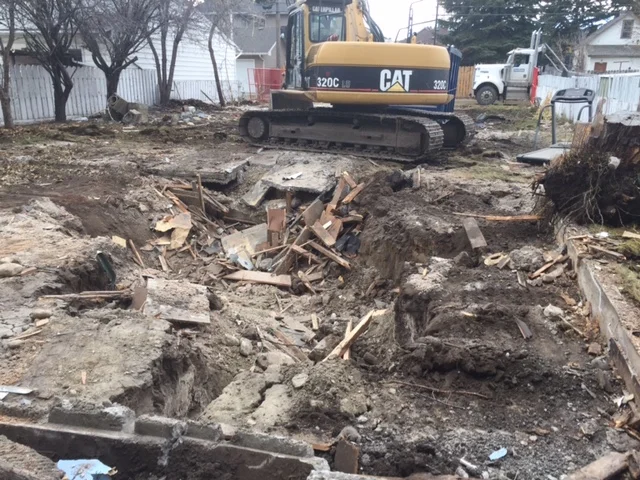
We have started the demolition at our 41 st project.  The demolition is always a satisfying part of the job because it happens fast, and it comes after so much time and investment has been made in design and permits, engineering, remediation and logistics.  Getting back into business  building houses is a welcome improvement over searching for land to buy, arranging financing, and dealing with community concerns about our lengthy rezoning application that is now complete.

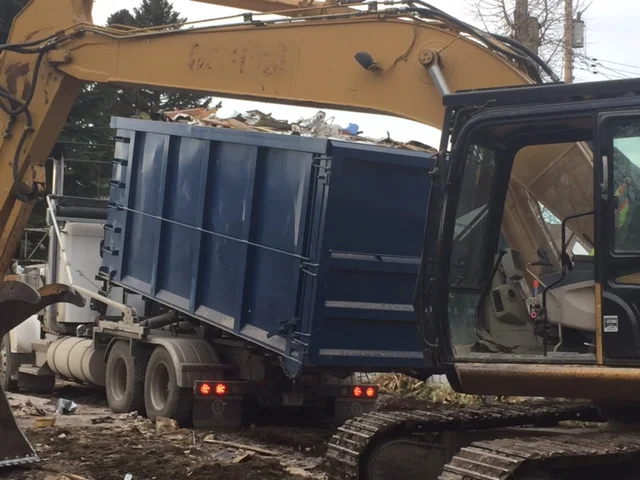
 We are using a new contractor for the demolition, he chooses to use large roll off bins to load the crushed material into.  It was amazing to see how he squeezed both the old house and the garage into two of these bins.

We have noticed many signs that the construction industry has become busier over the past month or two.  Good project sites have been selling quickly for strong prices and there is a noticeable push to get a bunch of basements dug before it gets really cold.  We are in a rush to get our basement poured so that we can connect the new sewer lines and get it all backfilled before the freeze.

With the demolition and excavation work progressing we can refocus on lining up the rest of the contractors that will take us to the drywall phase.  As per our usual practice, we have a schedule software and input the various trades into a continuous chronology that takes us to the major midway milestone, when the building is locked up and ready for the inspections.  We are also hard at work tuning budget and getting competitive pricing for the bigger parts of the job.

Next up will be surveying for the excavation and the dig itself. We will be pushing quickly into the cribbing phase and setting a start date for our framers.  Our goal is to have the windows in before Christmas, and this looks very possible right now.  


House is demolished and already loaded in the bin after just 4 hours

House is demolished and already loaded in the bin after just 4 hours

The second of two bins to be hauled away

The second of two bins to be hauled away

Rezoning for 2001 33 St SW Approved by Council

Rezoning Approved!

There is major news to report regarding my Killarney property located at 2001 33 st. The rezoning application from RC2 to RCG was passed 13-1 by City Council.  This means I can now prepare the detailed design of a three unit row-house project.  Before rezoning, the site could only support a single house because it is 12.7 m wide.  A City development bylaw does not allow a side by side project on sites less than 12.8 m in width.  My speciality in building is small townhouse projects, so building a single detached home on the site was not an appealing prospect.

The Mayor and numerous Councillors strongly advocated for the approval of the rezoning application.  I recall the Mayor said something to the effect that the City spent a billion dollars building a train and then didn't have any process to allow new houses to be built 300 m away from the station.  Our local Councillor supported my application, even though this meant he voted against the view of his own community association.  I recognize that took some courage, and I appreciate it.  

Council Critique of Consultation Efforts

I was told at the hearing that my community development committee consultation could have been improved.  I will make greater efforts next time. It is not exactly clear where I went wrong, but the one thing will not change is my commitment to building in Killarney.  

My first action was to hand out written material in a radius around the 33 St property.  I knocked on doors and introduced myself to the neighbours immediately adjacent. We had detailed discussions by phone on how the building would look, and I had a series of emails  with the owner across the street. This resulted in both of these neighbours supporting my rezoning application in writing, to the city staff. There were 11 written replies to council opposing the application.  The Killarney development committee (committee) had a written submission also opposing the application, it made a presentation at the hearing as well containing similar material. 

I did not have similar success consulting with the committee as I did with my neighbours.  I actually joined this committee earlier this year, to learn more about developing Killarney and to provide input on new applications.  Yes, this means a builder is on the committee, but I believe I can evaluate the applications of other builders in an impartial manner.  I am a fairly new resident of Killarney, my family moved in and were settled by late 2014, so my time with the committee/community is still very fresh.  

I have not had much success in even discussing the 33 st rezoning application with the committee.  The last two meetings were cancelled so the committee hasn't really met since August, and it hasn't discussed my application during an official meeting where I was provided an opportunity to present.  The former chairperson and I had diverging views on this application, particularly noticeable over email.  I requested a correction regarding public statements on my project that I felt were technically incorrect, and was declined.  This led to her banning me and another member from the committee until the Council decision.  I am hoping to rejoin the committee now, because I no longer have a pending application at any stage in the development process.  However, I soon will have a DP pending for the 33 St project - this would require me to recuse myself when details of my project are being considered by the committee.

Post-Hearing Reflections

After a major milestone such as this public hearing, it offers me a chance for some introspection on my actions/performance.  I believe I made a substantial effort at engaging the neighbours who could be impacted by my project, and brought the two closest property owners on board.  This has to be viewed as a success.  Next time I will door knock more neighbours and consider their input when preparing my application.

What were my failings in dealing with the development committee?  It had formed a principled stance against this type of project long before I had joined the committee.  This meant it had a consensus to oppose any such applications unless they were on 37 St (a major road, not a great place to build and sell homes).  It is not easy to engage in meaningful dialogue with a group that already has a well established opposing view.  My request to have the committee meet and actually go over my application was unsuccessful.  Discussing it over email with the Chairperson was the only communication available.  I was surprised when the last two meetings were cancelled due to lack of business, surely my project was a relevant matter?  

Another option would have been to bring in my professional design team to meet with the development committee.  Perhaps this could have allowed the focus of the application to be on the real issues. I will try this next time.

Our local councillor mentioned he thought my relationship with the committee could be improved.  I will take this as constructive criticism from someone who does community work every day.  I look forward to the next meeting and working with the committee.

Next Steps

To wrap this up, I am excited to begin the second phase of my row housing project as I believe my application for an RCG project permit may be the first one for Killarney. Inertia has promised to prepare the drawings in a short order.   My website will be updated frequently (www.integerhomes.com), and information will be posted once we have a DP submission ready. Once the DP is submitted, I plan to meet with the committee and work to understand how this project can reflect our community's vision and values.  My intention is to build a row house project that will enhance the 19 Ave streetscape and welcome new neighbours into Killarney.  


'Greening up' the demolition

This isn't another post complaining about that awful asbestos remediation work that seems to follow us around from project to project.  The current demolition site we are prepping for has provided us with some interesting opportunities to reduce the amount of garbage headed to the landfill.

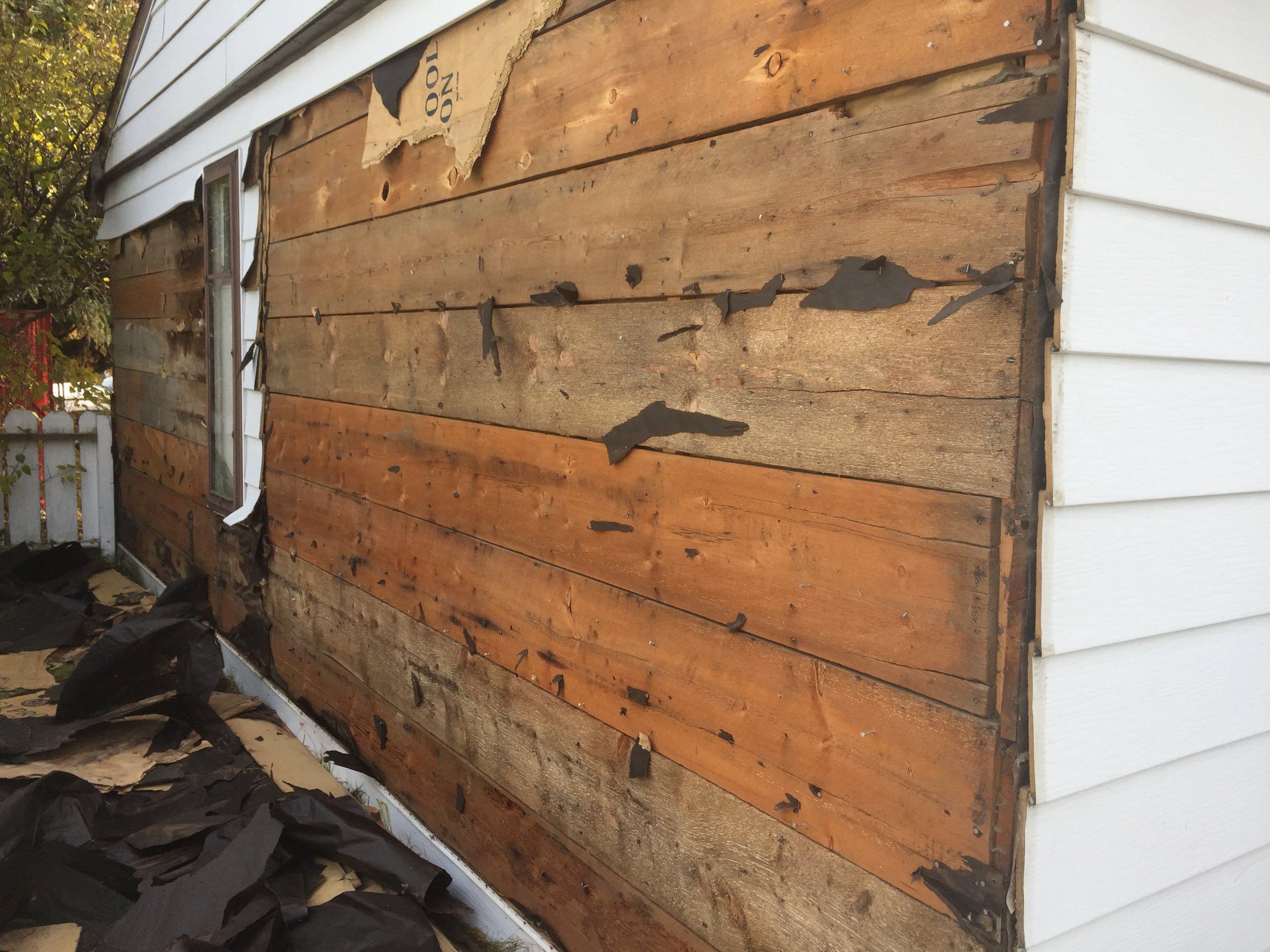
The house in question appears to have been built in 1952, however we now have reason to believe that maybe it was hauled in from another site and re-used in '52 as a house (judging by the hand dug style foundation it is sitting on this would make some sense).  This would make it far older than 1952, and, since it is covered in old growth 12 inch fir planks, the lumber could be multiple times the age of the house.  The house construction definitely predates the existence of sheet plywood product, fortunately the builders back then had old growth lumber that was so massive the dimensional lumber could be used instead of plywood sheeting material.  This product would be extremely costly to reproduce today.

We texted a photo of the material to our contact at red barn lumber, he is interested in having a closer look to see what we can salvage.  We will uncover the rest of the house and figure out what to do with all this old growth fir plank.  

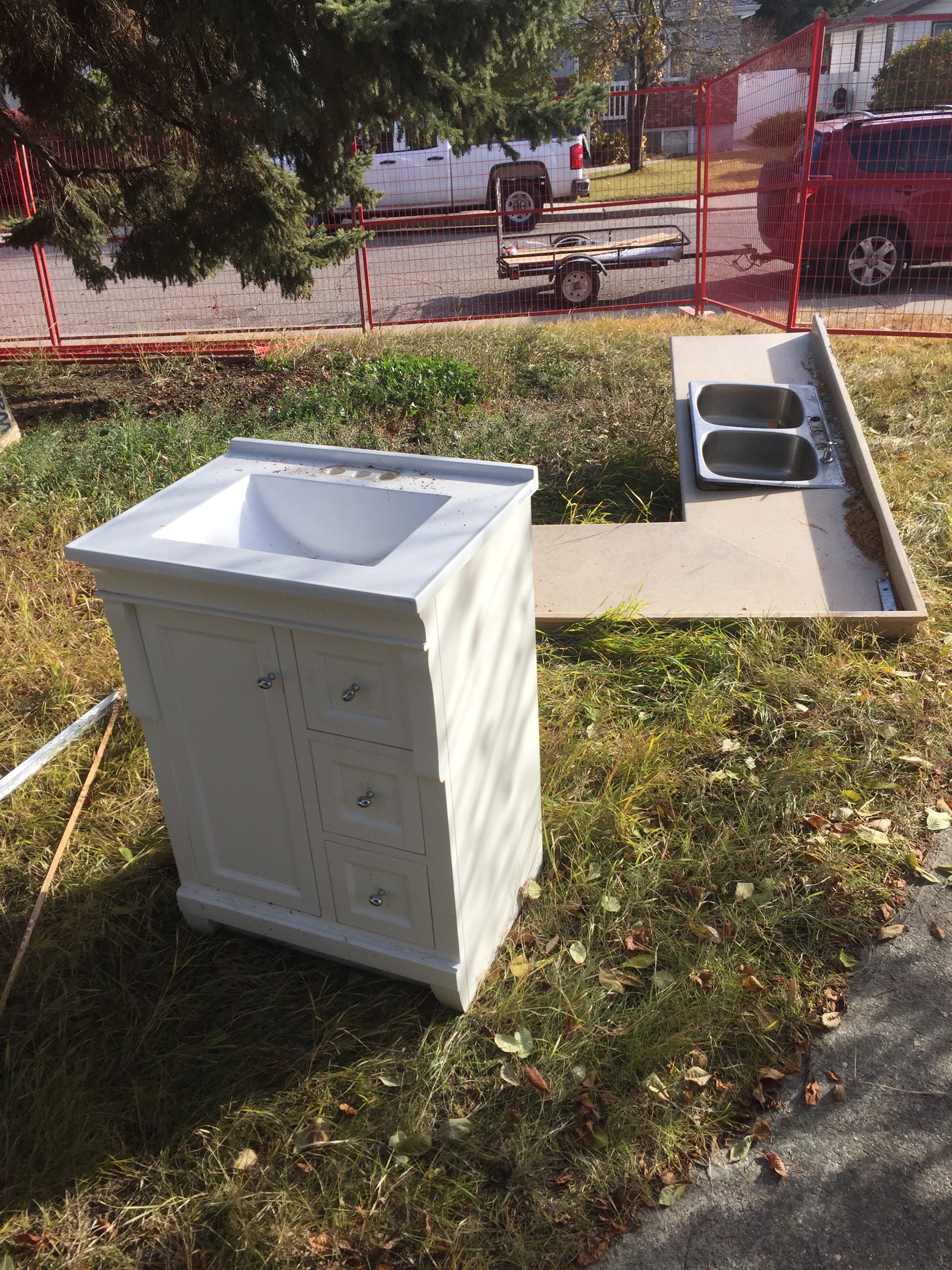
The second major salvage operation was the removal of the kitchen cabinetry and countertops.  We assisted in the removal and loading of the material into the trailer of someone we met on kijiji.  Hopefully he makes use of the cabinets, he hauled it all away for free.  At least this saved us the tipping fees.

Here are some photos of our recent salvage and re-use activity.


How To - A builders guide to the demolition permit application

UPDATE 2018 July - this post is now out of date, the City has created an online permit application system for the demolition permit.  While much of the process of collecting signatures for the utility shut offs remains the same, most of the work can now be done without going to City Hall.  This is a major improvement and saves the builder a lot of time and money!

The following is a comprehensive look at the complex and time consuming process of getting the demolition permit in inner city Calgary.  Most projects will require a demolition of an old structure on the property, so timely permitting is essential to ensuring a project can begin on time.  Any deviation from the process, missing documentation, or key signature absence will result in major delay and frustration to the applicant.  We suggest budgeting one month to provide enough time to compile the paperwork, attend the site and City hall repeatedly to navigate the process, and to deal with asbestos issues.  With some good fortune and experience, this timeline can be compressed.  In our last demolition permit attempt, we were able to get the asbestos sampling, remediation, service disconnects, paperwork and inspections done in three weeks of intermittent, but focussed effort.  The staff time spent including travel, parking, waiting, preparing documents, photographs, hiring contractors, fencing, planning and attending the site and City hall on multiple occasions was in excess of 20 hours (this would be very costly to outsource to a permit-fixing agency).  We would likely quote $2000 to take care of this process for a client (in part because the job takes a month, is often frustrating, and can consume days of staff time if procedures are not followed explicitly).

Note that we were able to complete the process in 21 calendar days, the current wait time for a single service disconnect (gas) is estimated at 35 calendar days.  We were very lucky to convince Atco to move us up the waiting list for disconnects.  To receive the demolition permit, some steps may be initiated while the house is still occupied by the owner or tenant.  This has its own set of pitfalls and risks associated with pre-initiating the disconnects.  The demolition permit process is greatly aided by having a staff person free to navigate the various site visits and offices during the work day, and who can respond on short notice to get the necessary signatures from the three key parties to the permit (ENMAX, Atco and Waterworks).  Feel free to contact us if this description is confusing or unclear.   We have done this a few times, but it hasn’t been getting much easier (and how quickly we forget these procedures - which is, in part, why we record this material in our blog post).  

Part 1 City Pre-application - Prepare necessary documents

download the city building permit requirement checklisthttp://www.calgary.ca/PDA/pd/Documents/carls/building-permit/demolish-or-move-a-building.pdf

prepare letter of ownership/authorization

site plan showing building to be removed (survey/real property report works)

photographs of house and garage and yard to be demolished

complete tree disclosure statement

complete asbestos abatement form (depends on outcome here of sampling)

hire demolition contractor and record name for City file

estimate building footprint to be demolished and estimate fee for permit

Part 2 Asbestos survey must be conducted

if no asbestos is found sign off asbestos clearance letter and file for use at inspection phase

if asbestos is found, locate a remediation contractor and conduct the remediation work.  Obtain an air sampling report and clearance letter from the contractor

Prior to any asbestos work being conducted the site must be fenced off.  Order and set up the fencing (or have the supplier do this).

Part 3 - Visit City Hall (1st time) and submit Pre-application Paperwork

If any document is not satisfactory the application will be denied

Upon successful review of documents, pay demolition fee (usually less than $200)

The applicant will now have the crucial document - the ‘Service Disconnection Request’ form.  Without this the actual demoltion permit cannot be issued.

Part 4 - Initiate service disconnects (this is where it gets tricky, and possibly frustrating)

Water Call City switchboard, attempt to speak to waterworks estimator.  If this fails, email them at waterservicesplanning@calgary.ca.  Within 5 days you will receive a service disconnection quote.  For some reason this is always $4250.  Unique properties may have other fees.  This is a remarkable fee because it is REFUNDABLE if you do the disconnect in the city street later.  No other fee we have encountered has this unique feature.  Attempt to make an appointment to have the water shutoff by the City crew.  If you fail here it is because you have not yet paid the fee (this fee receipt is an essential document you must keep to claim your refund later).  Upon paying the fee you can book the City crew to do the disconnect, usually a 5 day window is sufficient.

Visit City Hall (2nd time) - the payment window is located at the top of the escalator to the left.  This is the third floor of city hall.  Once again, ensure the receipt for the payment is not lost because it is essential to getting the refund later.

Electricity Call your electricity retailer to receive a permanent disconnect and reference number. Given the property is likely uninhabitable/vacant by this point, you may need to make an electricity account prior to getting a disconnection.  A site ID may need to be issued.  Make an appointment to have ENMAX remove the electrical meter.  This will be a multi business day wait depending on the crew workload.

Gas Atco is the company that controls this process.  Do not make the mistake of attempting to call Atco, this will achieve no result (we know this we have tried).  Go to the Atco office in the NW, we have found this the best option.  Fill out the necessary paperwork.  Atco may require 5 WEEKS to do the gas line removal, which requires the alley to be excavated to locate the gas connection.  It may be necessary to do this work many weeks in advance of when you actually need to begin site work.

Part 5 - Attend the Site to receive disconnect sign-offs by the three parties (warning - failure to do this properly will result in many delays and hardships.  Ensure someone can respond immediately to calls from the crews and attend the site with the disconnect worksheet).

This is the site phase where the applicant must (if you want to do this with any reasonable time frame) attend the site while the crew is working.  If you do so the form can be signed off. The same form must be signed by all three parties to the disconnect.  Either the builder or a staff person must be available to attend the site with very little notice.

Electricity - ENMAX crew is unlikely to contact the applicant. Once the meter is removed, you can email the blank disconnect form to SOC2@enmax.com and it will be signed.  Now you will no longer be working from the original disconnect worksheet, it will be a reprinted copy (legibility will begin to suffer)

Water - City crew will call when they begin the process because the water meter is located inside the house.  This is the opportunity to get the second signature on the disconnect worksheet so the signatures can both be on the same form, not two different copies.

gas - Atco will not likely call when they are on site.  If the crew is missed, Atco can be emailed to sign off the form. We will not publish the email address of the individual who takes care of this, just call the (403) 245*7506 Atco line.

Part 6 - Apply for the Demolition Permit and Call for Pre-inspection

Visit City Hall permit counter (3rd visit) to apply for the actual demolition permit.  The disconnect form will be reviewed for signatures.  If this is successful, the demolition permit can be issued immediately.  Demolition cannot begin at this time

Call the City switchboard and book an inspection.  This will be a pre-inspection of the house, at this time the asbestos related documentation must be produced for the inspector.  Fencing must also be inspected so it must be satisfactory

Part 7 - Actual demolition and Post-inspection

At this time, the site can be demolished (upon approval from the inspector)

Once demolition is complete, call for a post inspection.  At this point the city will be inspecting an empty hole in the ground.  Not sure why this is necessary...

Part 8 - Apply for refund of water service disconnection fee

The $4250 fee is not quite available for a refund, however, it will be once the new sewer and water lines are installed.  Generally the new water service is put in after the basement is poured, but it can be done much later in the project.  It is in the builders interest to get the water and sewer hook up done ASAP in order to reduce the cost of having the fee tied up at the City.

Once new water service is complete, email the waterservicesplanning@calgary.ca department and the cheque will be issued only to the name on file.  

*Note - while we have made every effort to describe the process in detail, some divergence from the process may be necessary, and changes to City procedure happen regularly.  These instructions do not provide any guidance on selecting the remediation or demolition contractors, what cost may be associated with these services, or how long this could take.  It is fairly reasonable to expect that this process could occupy the time for a single person sporadically over a period of one month or longer. Delays by the service provider will cause a domino effect of delays, as key steps must be performed sequentially.  Less significant steps can be performed in any order, such as conducting the asbestos remediation work.  Expecting an untrained staff person to attempt this process without guidance will likely result in very poor outcome, lengthy delays, and great frustration for the home builder.  Any suggestions on how to avoid having to attend City hall three times over a month period would be welcome.  

 

This is the gas line being cut off in the alley.  This is one of the three essential service disconnects that must be done prior to the City issuing the demolition permit

This is the gas line being cut off in the alley.  This is one of the three essential service disconnects that must be done prior to the City issuing the demolition permit

The demolition permit has now been issued...it was a lot of work to get the job done

The demolition permit has now been issued...it was a lot of work to get the job done

The perils of inner city house project financing

Our entry into new project financing was "easy", if you consider selling your family home, car and liquidation of all savings and investment accounts to raise the necessary funds, easy.  This got us over the hump and funded a duplex build.

The next project was four townhouses and that was beyond our reach, so we navigated the perilous world of commercial loan financing.  That was an awakening about the process and fees related to a commercial project.  

Given the recent recession, that avenue of financing appears to have dried up on us. The financing department seemed to think it would be possible to fund a project if we had presales.  This is fairly difficult to provide given that we haven't closed on the land deal, spent six months preparing permit documents or have any idea on when we could deliver a finished home to our customer. 

However, the other avenue of financing that is considerably looser is the personal mortgage department. They appear to be willing to advance loans on property in an individual name rather than a company name.  Even more attractive is the rates offered for individuals is far better than business customers.  We may be able to access project financing as low as 2.1%, this will give us the needed funds to deliver the best possible project at the lowest cost to our customers. 


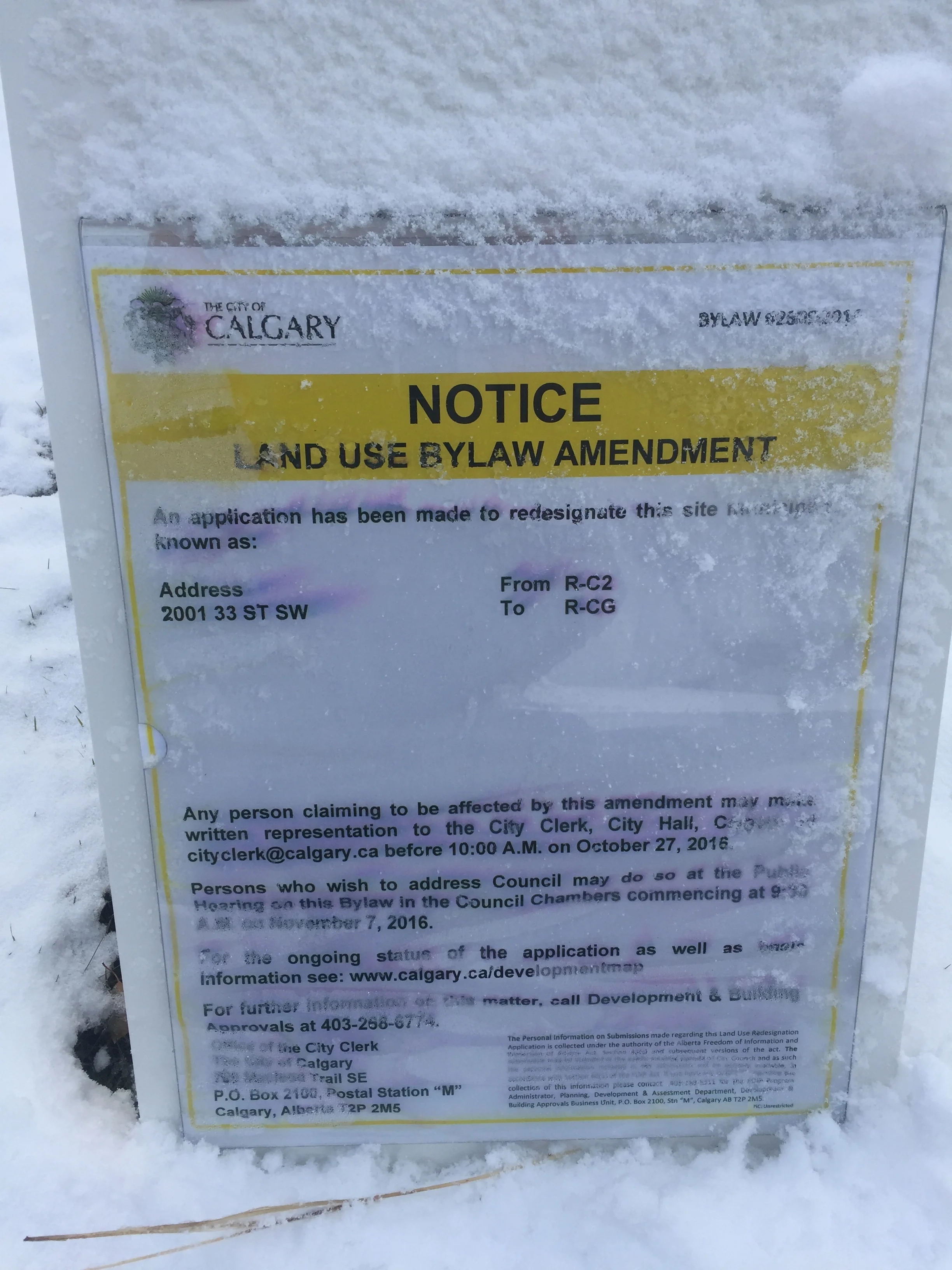
Rezoning update - public hearing notice is posted at the project site

We are now approaching the final, public hearing phase of our rezoning application for our proposed three unit townhouse project site in Killarney.

As announced earlier, this will take place at the November 7th council meeting.  This type of land use application requires the full vote of the entire council, and we are extremely hopeful that we will get a majority decision on the 7th.  

Our discussions with the Killarney development committee were basically fruitless, and barely occurred.  They didn't want to discuss any possible resolution of our application that didnt start with 'No'.  This contrasted heavily with the opinion of the city planning staff.   The staff examined the proposal and essentially agreed with all the major discussion points of our application.  Support at the political level is much harder to gauge though.

We have put a temporary halt on the development of the DP drawings for the threeplex.  Once the decision is made, hopefully in our favour, we will finalize the drawings.  We do have a very nice concept in place with generous sized two bedroom plus loft units, with a main floor office space. We think this project will be extremely unique and highly appealing to our clients.


The public hearing notice. Note the early snowfall that has accumulate already this year.

The public hearing notice. Note the early snowfall that has accumulate already this year.

Government meddling in the mortgage market...

Recently the federal government announced more changes to the mortgage market. The most significant change appears to be requiring buyers to qualify for payments based on the posted, rather than discounted rate. This is equivalent to having to qualify to afford payments at about 2% higher than a buyer would pay for over the course of a standard five year term.  

The Calgary market remains fragile during year two of our cyclical recession.  This market lacks the speculative fervour and foreign investment of the two biggest markets in the country. In fact sales and prices have been down for 22 months, not exactly indicators of a market needing government meddling. 

If the Feds were concerned about housing affordability they would actually tackle the gst bracket creep issue.  This long overdue change would make buyers eligible for gst rebate on new homes.  Instead the central banks own inflationary weak dollar policies have led to the higher sticker prices we have on real estate today.  Now even entry level housing is too costly to qualify for gst rebates.  

The massive tax grab on new housing is so typical of how hypocritical our government operates. On the one hand they feign concern at prices getting too high in some markets yet at the same time they benefit from the higher prices by taking 5% of every newly built home. Maybe the government should just get out of the mortgage financing and insurance market and allow the market to set interest rates.  This would be a lot more effective than setting national policy based on what happens in Toronto.  

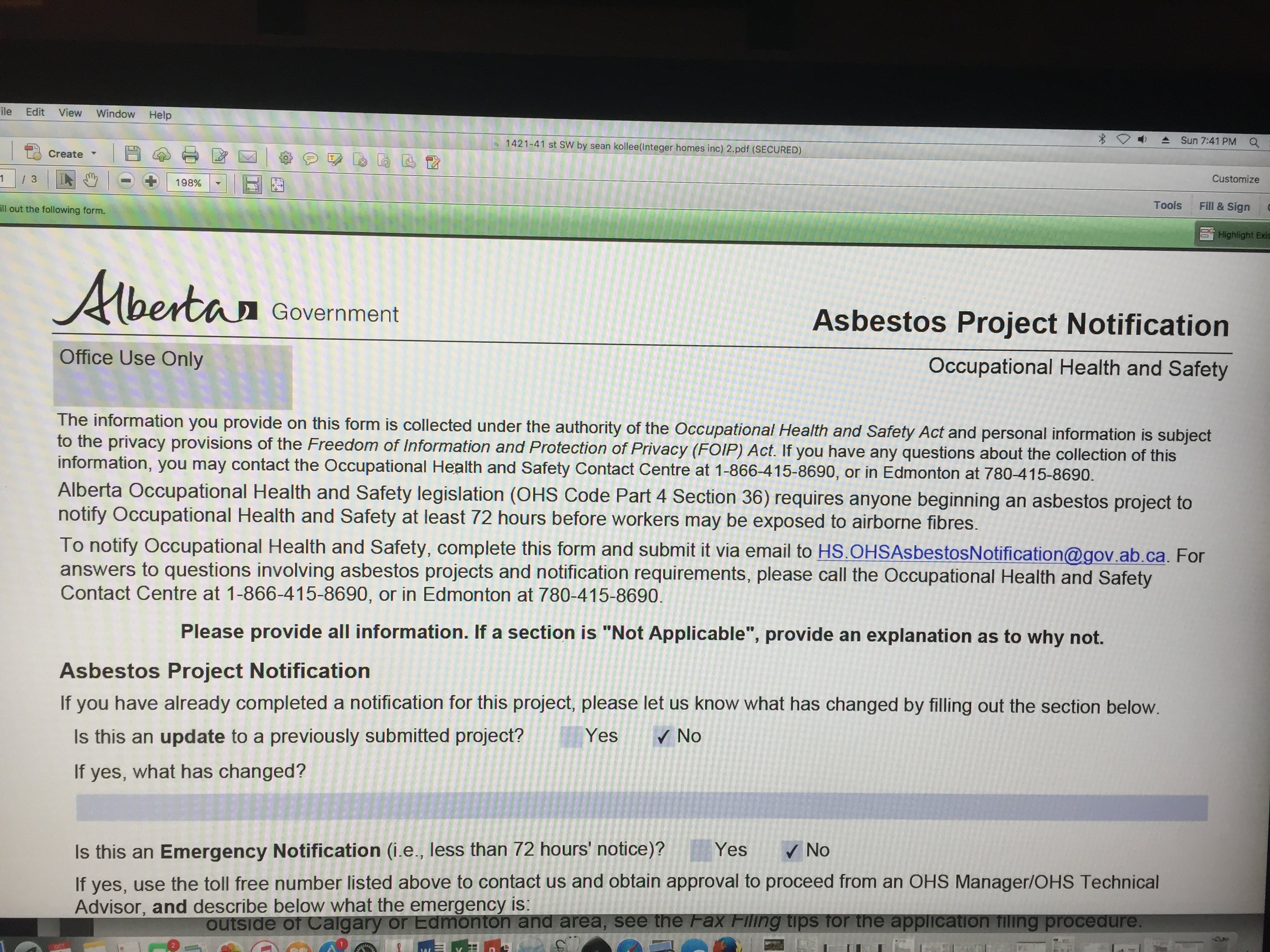
Asbestos again

The chronic asbestos infestation found in postwar homes follows us around the inner city as we demolish decrepit old shacks.  Every year the city adds a little more red tape to the process of demolishing the unsalvageable old homes.  You would think the city would be so pleased to have the private sector take care of this problem it would facilitate the paperwork process. Instead they burden the builder with multiple fees, payment windows and convoluted processes to pre and post inspect the demo sites, get the utilities shut off and use so much time that could be better spent building houses.  Hopefully we can get a demo permit issued this week on our 41 st project. 


IMG_3405.JPG

Welcome to Calgary - your fee is ready

Every time we start a new project in Calgary we wonder what the next fee will be for and what it will cost.  The previous year the City introduced its asphalt degradation and restoration fee schedule.  That cost can be very frightening if you are unfortunate enough to need to install a new sewer line in a road classified above the local collector category.  Budget for 2-5000$ here per project.

This year the City brought in the off site levy fee for sewer infrastructure.  They have a complicated formula for determine the fee and it is adjusted based on the location such as a greenfield site or in an established area.  Our fee added up to $1657 for a duplex project.

The City prefers to stick the builders with these fees as an approval condition, because it makes the fee impossible to avoid, and the fees can be tied to a 3.3% inflation increase (despite being in a deflationary recession the City ensures it gets a nice fee bonus each year).   There is an expectation among City staff that the builders can raise their prices and recoup the fee from the end buyers of the new houses.  We have also encountered an attitude among some City staff that as long as a builder company continues to stay in business, it must be profitable enough that it can absorb the ever increasing burden of City regulation and fees.

The fallacy with these fees is the builder has to pay for the cost but the community as a whole is the beneficiary.  You often will encounter a situation in Calgary where a long time landowner will have a low cost base on his or her property, say $25k, and the current land value is 50x that original amount.  Yet the city attaches the new fees to the builders for accessing infrastructure rather than a property owner who has contributed to wearing out the existing infrastructure for the past 30-40 years.  The preferential treatment of long time owner is also reflected in the property tax collected on older, primarily land value properties.  The assessment on such properties is lower than it should be.  So the City isn't collecting enough tax to pay for the needed infrastructure upgrades so must look elsewhere (to the builders) for more revenue.

The City also does not factor in its growing tax base from new inner city projects.  You will commonly find that the tax multiple from a new project will increase city revenue annually by a factor of three.  This means an old derelict house with a tax bill of $3300 becomes two new houses with a combined tax bill of $10000.  We often wonder why the City needs to introduce new fees when it receives such a significant annual gain in tax revenue thanks to the builders.


IMG_3387.JPG

New land deal signed today!

Great news our ongoing land search is temporarily over, because our project pipeline is now full for at least a couple construction seasons.  After a fruitless spring where we simply couldn't find a property to buy, we have, over this autumn season, been constantly finding leads to deals.  We have on three occasions been on the losing end of multiple offer scenarios, which has been frustrating, having to compete for land in the middle of a recession.

Since we are really focussed on a specific type of property that allows the redevelopment of our townhouse product, we reduce the scope of the land we want to buy to just certain streets in our preferred neighbourhoods.  These properties are often owned by the original owners or their children who lived in the homes in the 70's and 80's and now use them as rentals. They tend to be paid off and the owners are extremely disinclined to sell.  

This most recent purchase is in Shaganappi, we wont be more specific until the deal closes other than to say it is footsteps to the train station.  We really like the area, it is an up and coming inner city SW location with massive upside development potential.  In conjunction with the westbrook transit oriented development policy there has been massive public investment in the underground train station and library project, and a new area redevelopment plan that has rezoned many properties to MC2.  

As an added bonus the project location is within five minutes of our house and only six blocks from our daughters elementary school.  This makes it pretty easy to keep a close eye on the property.  


Huge apples growing in the yard of our new development site.  We picked this one today.  

Huge apples growing in the yard of our new development site.  We picked this one today.  

Rezoning update - planning committee recommends approval to council

Our rezoning application took a big step forward today.  The planning commission has now issued a recommendation to council to approve our rezoning request for the 33 st property. 

City planning and transportation staff were called upon to answer information requests from the committee.  The presented material from the staff was presented in a professional manner and added to the legitimacy of our application, and we appreciate their efforts.  Next step is the full council meeting in November. Unfortunately we expect this meeting to be more contentious with opponents given an audience to speak to the council.  We will be prepared to make a convincing presentation to council.

Council chambers at the Calgary City Hall, the scene of the Calgary Planning Commission meetings.  

Council chambers at the Calgary City Hall, the scene of the Calgary Planning Commission meetings.  

Rezoning update - Calgary planning commission meeting set

Our rezoning application for the 33 st project is steadily progressing toward a November date for the council vote.  

The next stage in the process is a recommendation for approval by the Calgary planning comission, better known as the CPC. The CPC meets regularly and accepts or rejects recommendation from city staff regarding land use change.  For our meeting in September, the CPC will consider a large number of what is now a never ending stream of basement suite application, a 90 unit condo project in hillhurst, and our rcg application.  

City administration has advised the CPC to recommend approval of our rezoning.  The Killarney development committee written submission opposed the rezoning. Unfortunately the development committee submission contained multiple factual errors and interpretations we don't agree with.  We can't expect an impartial submission but this committee is definitely showing an anti development bias.  We will report back here following the CPC meeting later this week. 


41 st Duplex project

Our design team has recently filed the development permit application with the city.  Once our permit is granted, we can file the building permit application and proceed to the construction phase. Right now we are occupied with budgeting and making the key material and interior selections.  Given the weaker than normal marketplace we will be reducing the specification somewhat from our prior project, but retaining the overall style and quality that we put into every home.

Once our actual construction begins at the 41st location, it will be a chance to validate that the modifications we made to our existing duplex design were correct.  We are the type of builder that actually lives in the homes we design and build, so we have a lot of first hand experience with the strength and weakness of any floorpans we develop.  We hope the continuous improvement mentality also allows us to lower the construction cost of our project as well.  

We will be updating our blog site with many photos and descriptions of progress at the site.  We are also continuing to seek out another property to purchase, preferably in the Killarney area.  Land supplies remain very low despite the apparent recession in Alberta.

Once we get to the end of our design phase we are making the smallest adjustments possible to the drawings to get it just right.  The red ink is all electronic these days, and our design team can now submit drawings electronically to the city, …

Once we get to the end of our design phase we are making the smallest adjustments possible to the drawings to get it just right.  The red ink is all electronic these days, and our design team can now submit drawings electronically to the city, saving both time and paper.  

Land deal closes

Our 33 st Killarney project has taken a big step forward.   With the land purchase finalized we can continue to focus our efforts on the permitting process for the threeplex we intend to build on the site.  Given the relative rarity of this type of building arrangement in inner city Calgary you could say we are threeplex specialists.  It appears our zoning change council vote could take place in early November. This could put us on track for a spring build, if all goes well.  

This is the property we purchased in Killarney.  While livable, the building is near the end of its life cycle without serious repair (which it won't be getting from us!).  Sometimes when we are in permitting disagreements with the communi…

This is the property we purchased in Killarney.  While livable, the building is near the end of its life cycle without serious repair (which it won't be getting from us!).  Sometimes when we are in permitting disagreements with the community association we wonder what it is they are trying to protect, especially when the concept of 'community character' is used to stop redevelopment.  

Rezoning update

Not much to report over the summer from city hall. It appears our project will find its way to the Calgary planning commission in September and on to council in November for the actual vote.  The process remains uncertain and from a timeline perspective is quite slow.  Ideally we could complete the rezoning and get into permitting right away.