Below cost of production sales - a common occurrence in the Calgary 2019 infill market

Remarkable ‘deals’ have presented themselves to the Calgary home shopper. Ample inventory and poor sentiment (thanks again to our self imposed recession brought to us by our virtuous leaders), have, after five years really started to punish the Calgary infill building industry. Notable among the disasters and business failures have been the builders basically selling their inventory at rock bottom prices just to move it.

To the buyer who is perhaps a little less discerning, willing to look to a less premium location within a good community, you can see plentiful sales involving utter builder capitulation on pricing. This has resulted in the rare opportunity for a buyer to pick up a new home where the builder has;

  • purchased the land and absorbed the cost of the market price of a typical 50 ft RC2 property in the infill communities

  • demolished the old house and funded the design and permitting process and associated fees

  • subdivided the parcel into two lots

  • completed construction and funded/financed this entire process and done the work of managing the build, no small task is this; and

  • Staged/marketed the new home for sale

So in addition to all the items mentioned above, the builder is now willing to sell to the client the home at or about the break even level, and guarantee the house by backing the warranty on it. All of this for zero (or negative) compensation despite a full year of investment, effort and the expertise necessary to build a house nice enough that someone is willing to buy it. If this isn’t a strong signal to jump off the fence and buy one of these properties I don’t know what is.

The business case for this project (or lack of one I guess) indicates this is a property that was sold for at or about the cost of production.  While I don’t know the builder behind this build, I can’t fathom how he could fund this land and construc…

The business case for this project (or lack of one I guess) indicates this is a property that was sold for at or about the cost of production. While I don’t know the builder behind this build, I can’t fathom how he could fund this land and construction project and sell it at the price he sold it for and break even. If high cost capital was used to fund this project, a loss is almost certain. Hopefully there is no warranty or service expense after the sale!

Unsellable property - the sad tale of 2503 12 Ave SW.

Economic theory suggests when the supply and demand curve intersect the optimal price of a product is realized. In real estate we tend to be a bit more into ‘plain speak’, so we’d say any house has a buyer at the right price. Normally I’d agree, even the ugliest most haggard house in Calgary can and will sell quickly at a low enough price. Just the other day we offered asking price on an old bungalow in a good area, it had strong rehab potential. Everyone else seemed to think so too and it sold the first day on the market at over list price with multiple offers.

Why then has a rough, old, unwanted and neglected house in inner city Calgary, with a good size and zoning (rc2), in a very good neighbourhood, near a really nice green space and skating rink, adjacent to the bike route downtown not sold after so long? Surely dozens of eyeballs have scrutinized this place and all come to the same conclusion to cross it off the short list.

Priced at $518,900, 2503 12 ave sw should be able to sell given a casual glance. It is under the market price of a similar Rc2 zone property in the community. It even sits on a corner meaning it generally has a premium to sell because it is easier to access and up-zoning potential to the row house zone is quite feasible. The problem is that the house is rough enough that no end user or retail buyer wants to live in it, and no investor wants to pay the asking price and make repairs because the yield is too low. I’d declare the yield is non existent, and for an old house with a lot of potential costly trouble areas it could take a lot of money to make it habitable for years to come. And after sinking many new dollars into it, you’ve still got a crappy old house. So issue a), it is not appealing to home buyers, and issue b) it is not appealing to investors to rent out. That must mean it appeals to builders who want the lowest cost land possible to demolish old houses and build new semi detached homes? Yet due to the location, overlooking the highway into downtown the setting is really unattractive to a builder. The builder would have a really rough time selling the finished houses to, you guessed it, retail home buyers, who tend to be extremely picky when selecting a home. So issue c) with this property, it isnt appealing to builders either. That means this house is basically appealing to nobody, thus it hasn’t sold. And the tale grows worse, let’s discuss issue d) there is a major retaining wall failure along the side property line. This retaining wall is holding up the grade on the neighbours higher side. Regardless of who’s fault this is or what must be done, this is a costly disaster. It’d be most unappealing to an investor because fixing retaining walls has no value or rental yield. Perhaps a builder would be able to tackle this with the house demolished, but then you are coordinating working on a neighbours property to dig in a new and very costly wall, that likely is the neighbours responsibility to manage. That means wasted time, aggravation, and potentially unsafe worksite conditions. If you add up a+b+c+d you’ve got a nightmare scenario. A pity this lot sold for $510 back in 2013, there may not be even enough equity in the property to deal with the slope stability problem.

So why dont they just drop the price until such threshold is reached that it now appeals to somebody? Well, to me, as the potential builder buyer I really dont want it even at $100k less. I dont think I even would want it at $150k less (after deducting the cost to fix the retaining wall). For me, I’d have to discount whatever I build there by some unknown but colossal sum, making it very risky. There is a good chance that even after factoring in a mighty discount I still would be stuck with it (my own unsellable property). And the horrible location does not translate into lower construction cost to rebuild on it.

What you find in the inner city is cost to build anything, anywhere, is remarkably similar. To get designs made, pay for city fees, dig a basement, pour concrete, buy lumber, these inputs are not related to ‘value’. They just cost the same everywhere. If you are going to incur a lot of input costs, you are best served to funnel your investment into a worthy location where the additive sum of the parts will be something the end buyer will value. With 2503 12 Ave SW, there simply isn’t anyone yet willing to invest real dollars, at 2020 construction pricing into such a flawed location.

The fallacy of the realtor community (generally), and the owner of this property, is they have this mindset that the locational harm of the value of this site is only a small amount compared to a much better location. So they come to the quick conclusion that a house in community X is worth $600k, so this one must be worth that same $600k less a small chunk taken out, say $80k. Yet we’ve found that after so long on the market, the market is now clearly saying the 2503 12 Ave site is not worth the discount they are offering. This is because they are unaware that the investment to rebuild this site isn’t just the land cost, it is also the build cost which cannot be discounted very much over competing prospects. If the build cost to do a new semi detached home is $800k, then the land at $519k represents only %40 of the project cost. But the discount they’ve offered to the builder from a value of say $600k to $519k is $80 or 6% of the project cost. To the builder, 6% is a tiny amount to save compared to the future discount of the newly built home (I am guessing $200k of project value is harmed).

Given these rough numbers, it appears I’d need another $200k of discount to be attracted to the property. That’d put the land cost at $319k. Yet even at that number I’d have some serious reservations. This is because my personal effort to build a house is identical on a good lot vs a bad lot. I don’t want to undermine my management efforts by directing them into a bad site, when I could easily buy a much better property that I'd be excited to work on.

I doubt the owner would ever sell at a price I’d offer to buy this lot at. They’d be insulted by the bid, or feel I’m trying to steal it. This is why I have declared the property at 2503 12 Ave Sw to be unsellable. Now that I’ve gone ahead and published my thoughts on this site, it will probably sell! But it won’t be to me. The future of this property is unknown, but I suspect that it may require extremely tight market conditions where buyers are less discerning and more willing to overlook horrible problems like soil stability and imminent retaining wall failure, traffic noise and poor resale potential.

This is not it. This is a photo I found on the web. These houses probably have more potential than 2503 12 Ave SW, because they can demolished cheaply and made into farmland.

This is not it. This is a photo I found on the web. These houses probably have more potential than 2503 12 Ave SW, because they can demolished cheaply and made into farmland.

This is the property in question. I have declared it to be unsellable. Will someone buy it? It would be fascinating to see it sell, to find out who buys it and what they intend to do.

This is the property in question. I have declared it to be unsellable. Will someone buy it? It would be fascinating to see it sell, to find out who buys it and what they intend to do.

Site painted cabinetry - luxurious finish spec or laborious nightmare

I like to introduce the occasional wrinkle into the build, this either keeps me interested or creates some unwanted havoc or hardship at the site (or all of the above). Over the years I have grown either bored or unsatisfied with the end product in certain situations when using pre finished (factory made) cabinet products that are then assembled from cut pieces at the site. The issue is the pieces, often gables, trims, mouldings etc, dont ‘mitre’ well, or butt together well and you have a lot of unsightly seams, gaps, joints, or reveals that do not appear as nice as I’d like them to. This is not avoidable because the factory provides sheet products, not edge banded or mitred trims that are custom to each job.

One option is site painted doors and trims. This has an unwanted effect of creating a lot more work for the finishing painter at the site that formerly would not exist. The site painter doesn’t have the advantages of a commercial paint booth to work from, he must do everything inside the dusty and imperfect job site. However the advantage is all the instances where the trim is up against the ceiling, walls, or other objects the finish product can be much better integrated. The skill and attentiveness of the painter (and products used) is a deciding factor in how, from the builders perspective, the site painted option will be measured against the typical pre-finished product.

So it appears the site painted cabinetry is both a luxurious specification with potential to have a superior outcome and also a labour intensive nightmare. As the job progress moves along we will determine if the extra work and cost is overcome by the quality of the end product. For now we’ve got the first house ready to go at the K35 site and the pain stage is going to be wrapped up before the holidays begin.

Much paintwork yet to come.  Will the end product quality justify the additional time/cost/effort on site?  Hard to turn back now!

Much paintwork yet to come. Will the end product quality justify the additional time/cost/effort on site? Hard to turn back now!

Currency debasement practiced by terrible monetary policy and inept governments preying upon the good citizens of Canada - case study the tale of 6308 Lacombe Way SW

Very little is ever heard, or even discussed today regarding the utter destruction of the value of Canadian currency over the past 50 years. Especially during a Federal election, when such issues could be debated in order to determine what aspiring leadership candidates might do about this type of problem. These topics are utterly verboten when the media can discuss fascinating topics such as the horse race, black face, or exposing identity politic moral positions on what genders are allowed to wed.

Back in the good old days, the time of hippies and the Vietnam war, the $CDN could buy you a whole lot of stuff for what appears to us today, to be very little. In fact you could buy a pretty nice new house in a pleasant suburb for under $15k. And that identical house today, totally original and un-renovated appears to be worth as much as $465k. Some people react to this type of evidence of the ravages of inflation on the value of the dollar by uttering some comment like ‘well the wages are higher today’. One wonders, if the wages just stayed the same as they were, and houses also about the same price, wouldn’t you be way better off? Can you not see how the price of hard assets such as real estate are vastly more costly in currency than wage inflation has been over the decades? Perhaps the central bank having an inflation target may do more harm than good to the 99% of people that go about their lives working and saving so they can eventually retire? Lets take a look at the value of the $CDN since the property we are studying today was last transacted.

So that $13,5k back in ‘66 would get you a new single house. Today that same money has the purchasing power of $105k. What kind of house can you buy in Calgary for $105k in 2019? Well I can tell you what it will buy, a total POS tiny condo that has …

So that $13,5k back in ‘66 would get you a new single house. Today that same money has the purchasing power of $105k. What kind of house can you buy in Calgary for $105k in 2019? Well I can tell you what it will buy, a total POS tiny condo that has a monthly condo fee of around $500 per month. Just the condo fee over two years will equal the cost of a house in 1966.

Back in monetary fantasyland of 2019, the house purchased for $13500 in ‘66 is in horrible condition, basically unliveable, is worth a claimed $465k (no way it is), and needs another $100k in immediate renovations, so its true cost is closer to $600k. Yet our inflation tool tells us that $13.5k from ‘66 is only worth $105k. Is it possible our wise leaders have been dishonest with us regarding the value of the currency it controls and prints over time compared to what the economy says about the value of tangible assets?

Can it be the the real purpose of the inflationary policies of the central banks are to rob people of small increments of their purchasing power over time such that the outcome is total debt servitude to the financial elites? For families to put a roof over their heads must they work themselves into an early grave while passing on their remaining mortgage to their heirs? Surely there is a better way to live than enduring exploitation. Maybe in a future post I will illustrate some strategies on how to overcome the ravages of the banking sector on your personal freedom.

This property is a tribute to our great and wise and utterly useless political class and their bankster masters, thanks again to you for destroying the purchasing power of our currency and through this monetary debasement enslaving future generation…

This property is a tribute to our great and wise and utterly useless political class and their bankster masters, thanks again to you for destroying the purchasing power of our currency and through this monetary debasement enslaving future generations of aspiring homeowners to debt servitude in order to better enrich the financial elites of society.

Bad scheduling means project slowdown

Oft times the difficulty in getting the schedule correct nullifies the value of even having a schedule. Such is the curse of attempting to be an organized builder. My gantt charting system is only as good as its operator is wise, and in this instance the operator erred. You’d think by this time my schedule template would be a bullet proof means of rigid order of operation and time allowance for each stage of my build. Seems like the k35 project threw a wrinkle into my schedule because we are doing more of a site finished kitchen and it takes considerably more time than I’ve given. Congestion and domino effect is the outcome. Despite all this, the kitchen cabinet delivery is under way. That’s always a nice project milestone to celebrate. After kitchen install is a whole lot of paintwork that will take us into the holiday season.

Large delivery of cabinets and install will be expedited.

Large delivery of cabinets and install will be expedited.

Revisiting an old favourite

Just looked up a property that was featured in a few posts over the last while. It seems to illustrate the danger quite well of building spec homes in the inner city. Many people have contacted me over the years to build for them, or whom want to build themselves. I should just show them this photograph and say ‘so you wanna be a builder’ and then giggle like a maniac. This is a tough market and you’ve got to be good and resilient to survive. Just the apparent losses on this property exceed the land price I paid for my first multi family build. Ouch.

What is the market value of this property?  We just don’t know until it sells. It has been listed and delisted a few times over the years.  Good location terrible price. It just shows that in any segment of the market you can lose your shirt.

What is the market value of this property? We just don’t know until it sells. It has been listed and delisted a few times over the years. Good location terrible price. It just shows that in any segment of the market you can lose your shirt.

Interior finishing stage underway k35

While we’ve made good use of the unseasonable weather outside we’ve also progressed right through the drywall stage on the inside. So with boarding, taping, sanding, texture and now priming done we have started the interior finishing stage. The process to get to finishing took about two work weeks with some lost days for crew changes, deliveries and routine double booked trades that weren’t always available immediately. In between we got the furnaces fired up and the permanent electrical connected and a few lights and plugs turned on. The first finishing crew does the door hanging, casing, baseboard where possible and also the closets and shelves. This is a good deal of work and depending on the crew size (2-3) will usually be 3-4 days. In this build we have the kitchen supplier producing the mudroom and master closet cabinetry in their shop. This is another large amount of work but will increase the consistency and precision of the end product by having it all produced in a shop and site painted.
Progress to date has been good on the k35 build, at the three month stage of the process we have interior doors hung and it really starts to take its final form inside and out.

The interior work is much more detailed and slower than the earlier stages but also warmer so a better place to be in the winter.   It looks like we can have this project finished inside by the end of February even factoring in some seasonal shutdow…

The interior work is much more detailed and slower than the earlier stages but also warmer so a better place to be in the winter. It looks like we can have this project finished inside by the end of February even factoring in some seasonal shutdowns. My preference is not to finish builds around Christmas because it isn’t a great time to sell them. Unfortunately the way our seasons work if you start in the spring which is ideal for pouring basements and framing houses you inevitable finish by Christmas. We started in August and we’ve missed out finishing 100% of the exterior and even landscaping it by a few weeks. I need to start my next builds a little earlier in the year because seasonal delays are costly and frustrating.

Mid November stucco

Another Chinook and we are able to use every day available to us to finish a major stage of the exterior, the scratch coat. The current plan is to wrap up the stucco this weekend and then demobilize the scaffolds and return the rental fencing. At this stage of the project the rental fencing is just a huge hassle to deal with. The rental fencing is basically universally hated as a useless obstruction. It somehow became necessary to use due to concerns about safety. My view is that anyone who trespasses into a jobsite can suffer the consequence of their travels. And anyone who intends to trespass into a job site can open a fence. The situation is just another ridiculous cost applied to inner city building.

IMG_5917.jpeg
And the scratch coat is done as of mid November. I think it is the latest I’ve ever been able to do stucco. Heating and tarping the entire building is possible but that is a lot of work and expense we’d rather avoid.  We do have the issue of the acr…

And the scratch coat is done as of mid November. I think it is the latest I’ve ever been able to do stucco. Heating and tarping the entire building is possible but that is a lot of work and expense we’d rather avoid. We do have the issue of the acrylic finish coat to do and that may wait for spring.

Exterior progress - k35

We’ve managed to get a reasonable amount of progress made on the k35 front exterior. Note the large load of sand in the yard where the dump trailer normally sits. That is a sure sign we will have the stucco scratch coat starting next week. The windows and some exterior detailing has been a bit of extra juggling and planning but is coming together nicely. Once we get the stucco done that is our last exterior work until spring.
Note the functional gable vents on the top of both walls near the roof line. These vents are cut well above the insulation in the attic and greatly contribute to venting any humidity trapped in the cavity in winter.

Siding is looking good and scaffold is up

Siding is looking good and scaffold is up

Market discipline - so painfully slow - how to lose $180,000 in three years.

As an observer of the typical real estate related mistakes that people (me too!) make there has just been such constant fodder recently. The slow motion debacle of these misguided valuation ideas is so cringeworthy to me that I cant help myself but feature it on this page. Today has an interesting case study, one I have watched unfold over three years, and now there is a new chapter in this sordid affair (property is now on the market, finally).

The property in question sold exactly three years ago, for $850k. I was shocked at the price at the time, and angry that it sold at that inflated value. I was interested in buying it at perhaps $100k but preferably $150k less. That would have been something I could work with. But at $850 it was just such a terrible deal, there was no way based on my math (recall that math is hard, but this math wasn’t that hard at all), that this business prospect could ever pencil out as anything but a disaster.

To make the scenario even worse the buyer then later approaches my realtor and informed him of his grand ambitions. My realtor then gave an educated market value estimate based on real data, like any good realtor should do (and while he’s a polite dude, the message was not good at all). Of course, the realtor who was actually the one taking the commission on the land deal was nowhere to be found. He’d taken the cash and was of no further use, likely didn’t know the first thing about infill development. This is one of the many dangers of using terrible realtors when making critical purchasing decisions. The client will get terrible advice and act on it, and the realtor walks away with no liability to the disaster left in his wake.

But this post wasn’t intended to be a diatribe against my favourite topic, bad realtor behaviour in land deals. It is supposed to highlight the danger of infill development. Nobody discusses the failures, but you will see plenty of success stories featured prominently. Well here is a huge loser to report on! And the story isn’t over so we cannot tally the losses definitively (but we sure can make a detailed estimate).

Here is some dates provided by Honest Door.com, an interesting and free resource for real estate investors. It shows the last sale, data from the land titles office, and the current assessed value and the ‘honest door algorithm’ price. They have it …

Here is some dates provided by Honest Door.com, an interesting and free resource for real estate investors. It shows the last sale, data from the land titles office, and the current assessed value and the ‘honest door algorithm’ price. They have it curiously down at 738400. This could be accurate. The other interesting feature of this property is the old house was demolished. So many buyers can no longer buy this lot and it cannot be financed easily by conventional means. This could drive the price down even more - do you have $734k in the bank ready to go and want to put that full sum into this property? I sure dont…

here is the title from the old sale. Ouch. At 850 they have now paid property taxes for 3 years, that is about $15k. Then they lost the time value of the money, at 5% per annum, that is $42.5k/year x 3, that is $127.5k, plus the cost of the demoliti…

here is the title from the old sale. Ouch. At 850 they have now paid property taxes for 3 years, that is about $15k. Then they lost the time value of the money, at 5% per annum, that is $42.5k/year x 3, that is $127.5k, plus the cost of the demolition, so lets call that another $10k. Losses are now already at $152.5k and counting…plus realtor fees to sell it, current list price is 795k, if it sell at that price less commission, that is another $28k in commissions. Total loss is now at $180k on this purchase. That really hurts

Another unknown here is this land investment may even have been financed, if so, the losses are further magnified by interest charges. the loss of investment opportunity to the owner are harder to quantify. If this lot was bought in cash, the return that could have been otherwise earned on the stock market or another investment is tremendous and impossible to measure. The losses could easily be more than the $180k that I’ve estimated here, a lot more. Many buyers don’t consider the time value of the funds misallocated to real estate as a loss. They’ve been lucky to buy into up markets where the money factor involved is negated by increases in values. This hasn’t happened in years in Calgary. Buyer beware!

Back to garage building

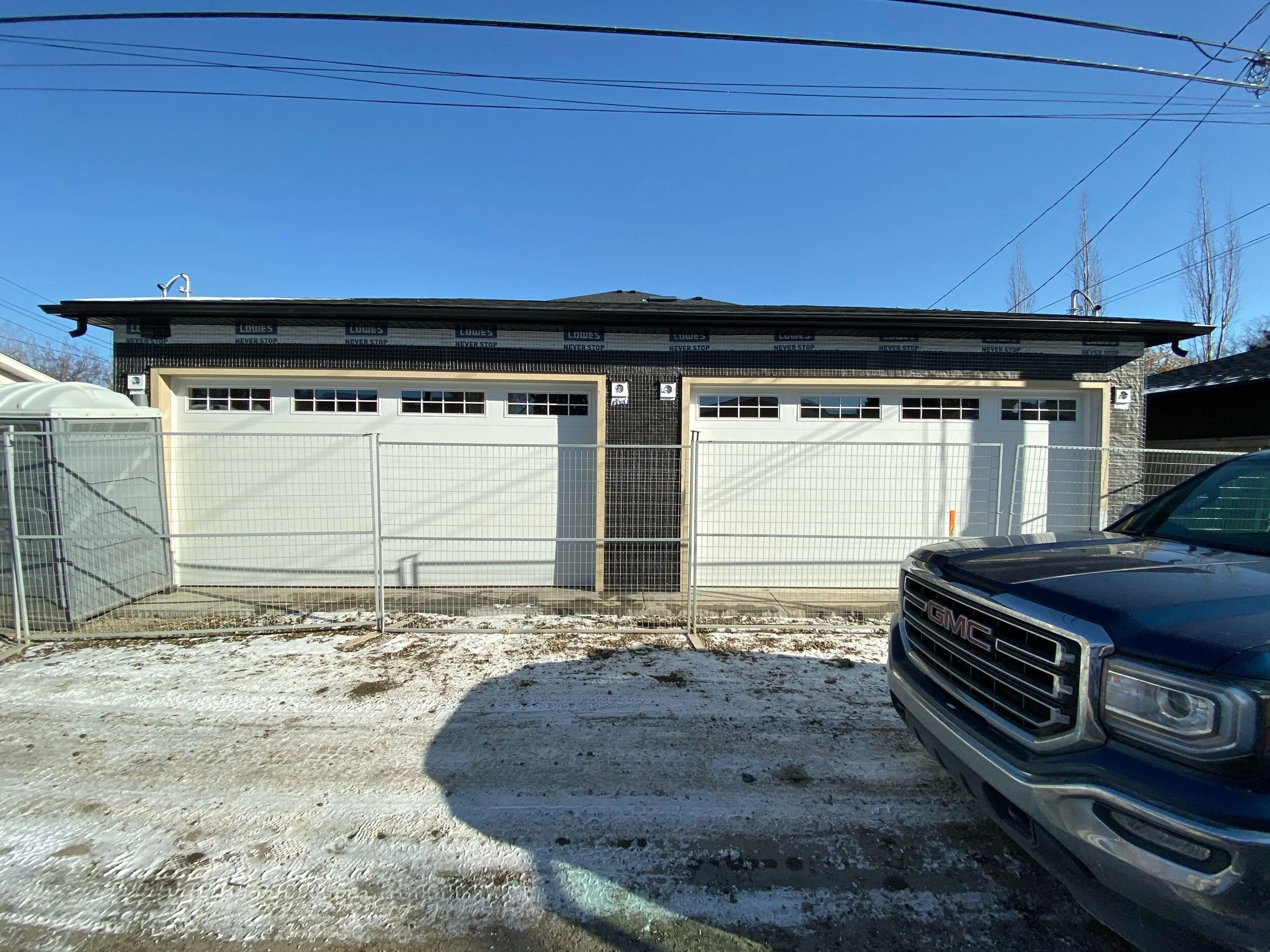
I rarely break out the cost of garage building as much of the labour blends into the larger project. Items like stucco, drywall, electrical and others are not necessarily broken out from whole house contracts. Despite that I’ve got a pretty good idea on the cost of a four bay garage that you can do in a cost advantageous manner when blending it in with the rest of the build.

More garage progress. Almost done.

More garage progress. Almost done.

Drywall details - joint reduction

The same crew hanging the board also tapes it. We are using a four man crew, and they are skilled at both tasks. Because they also need to finish the board they hang, it is in their interest to make it as nice as possible and minimize the joints. This resulted in selecting the 54 inch drywall vs using two rows of 48 inch board and a middle strip on the 9 ft walls. When you see a boarded room you can see not only how few joints there are to tape, but also how few screws are needed on the partition walls, as they get the studs glued before hanging. So not only do we get a finish with less visible joint risk we should also get less screw pops too. Seems like a win win for the builder and the subcontractor.

Preboard summary - K35

As we’ve reached the drywall stage of the project, it is a great time to review how far we’ve come since we started the demolition and excavation in early august. We have enjoyed a lot of cooperation from the trades and even the autumn weather. This project was among the most carefully managed I’ve been involved with to date, with lots of staging and orchestration gymnastics to run multiple crews, usually 6 days a week and sometimes even 7. With footing pour on August 9th, and drywall hanging underway September 25th, that is only 11 weeks from an empty hole in the ground to a structure complete enough inside and out to cover it with drywall and start the finishing work.

Of that 11 weeks, or 77 days, we’ve had a bunch of rain storms and blizzards, holiday long weekends, waits for material and equipment, and scheduling conflict among various subtrades. The construction has certainly been a whirlwind of activity each day, and required a lot of management time to keep on track, and on budget.

fullsizeoutput_bc2.jpeg

The green sticker means permanent power

With the garage wiring done and the permanent power service installed, we had our inspection today and this means new meters will be installed. Once connected by Enmax we will have power and lights installed plus the all important furnace connected.

IMG_5647.jpeg

Winged rats strike back

These flying rats are calling out for extermination. With just one open spot in the building they found it and are preparing for a nice evenings roost. I’m going to look for my slingshot.

IMG_5662.jpeg

Spray foam stage

Lots of large cantilever at the k35 project so they’ve received a nice coat of 2 pound spray foam. Next up is insulation of the rest of the house walls and stucco prep. Drywall delivery is early this week so we’ll be making a lot of interior progress soon.

IMG_5632.jpeg

Permanent electrical service underway

Typical procedure in the inner city build of a laned parcel. Get the house up and the sewer installed into the street. Get the gas company to trench and pipe gas to the house from the alley. And then struggle to get the garage built so that a mast and submeter can go on the garage and then a trench and line fed to the main panel in the basement. Once complete, the builder can do two items of considerable importance. Energize the panel for lights and turn on the furnace. After we get to drywall no further work can be done without heat inside. And the heat needs to be consistent and humidity managed all winter, a real challenge to accomplish.

Ground plate is dug in 6 inches deeper than the trench.  Lots of digging is done and more to come.  But the project is on the cusp of being fully serviced, always a real accomplishment and project milestone.

Ground plate is dug in 6 inches deeper than the trench. Lots of digging is done and more to come. But the project is on the cusp of being fully serviced, always a real accomplishment and project milestone.

Where to locate the shower niche

We’ve installed a shower inside a corner with two exterior walls. Not exactly ideal for the shower niche. Only one spot remains and that is below the shower mixing valves. I think this will turn out ok once we get the tile selected and the shower walls prepped.

The niche will be installed below the shower controls. Better here than inside the insulation of an exterior wall.

The niche will be installed below the shower controls. Better here than inside the insulation of an exterior wall.

Construction randoms - protecting finished materials from the onslaught of stucco

Long time without a post. We’ve been out of town for a week and pushing on through the non photogenic stage of prepping for the all important preboard inspection.
A good construction practice is applying the vinyl decking before the stucco so it can wrap up the wall. The stucco is then flashed over top the membrane. This is great but this means active stucco work with sharp object, pipe scaffold, mud, wire and boots possibly destroying your finished deck vinyl. We must go to extreme lengths to manage this problem and covering the deck is the only viable option.

Vinyl decking is all covered with osb material to offer at least some protection for the valuable finished product below.

Vinyl decking is all covered with osb material to offer at least some protection for the valuable finished product below.