Weekend progress

The framers were back and started framing out the basements.  This will allow the following trades to compete the basement as if it is part if the first mobilization rather than a second project.   

To the builder, going from a dirt basement floor to a heated and cured slab with a framed product in a week is really fast.  At this pace we will be through plumbing, mechanical and electrical in a month ready to inspect and start drywall. 


IMAGE.JPG

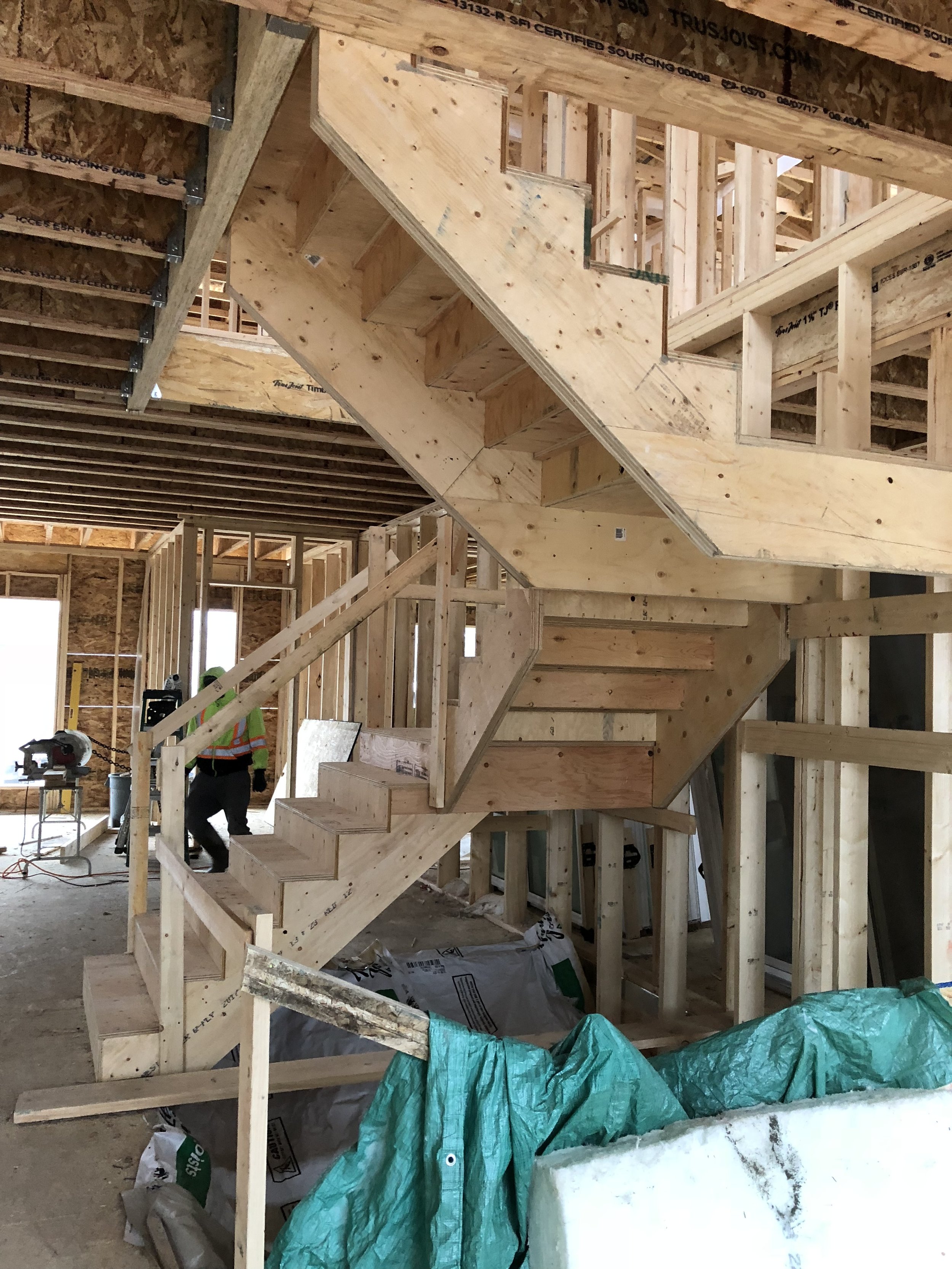
The temporary stairs are still useful.  Landings and basement treads are ready to be built.   

Dirt management and the rowhouse excavation

I hired my favourite excavator to dig the row house basement. I knew the rowhouse would be extra tricky given the sunken patio and walkout cut.  All of this means more excavation, more accuracy and more backfill.  The sunken patio took an extra day to dig. I’ve already complained that my cribber is charging me the same price to crib the tall walls of the sunken patio as the remainder of the three basements.

Next we underestimated the volume of dirt to come out of the hole. The city has restricted dumping at landfills such that the only available dump zone was the south Calgary health campus.  That would be a huge commute.  We decided to dump the surplus dirt at my other Killarney house so we could retrieve it later.  This saved the round trip commute of 10 gravel truck loads.  That may have saved 20 hours of travel time that was better invested in digging than trucking.  

The excavator was still digging as the surveyors arrived to mark out the footings.  Enough was marked out such that the footing crew can begin right away.  We’ve got the cribbers lined up to start as soon as they finish another Killarney row house only 10 blocks away.  Sometimes I get lucky with scheduling and other times it is a total fiasco. Today was definitely on the lucky side to have a free dumping zone and to have the surveyors and footing supplies arrive at the proper time.  Now we need a little luck with the weather ...


IMAGE.JPG

a lot of dirt and nowhere to put it. We need a lot of backfill so we left dirt in the front yard and back yard, and even at my other site.  

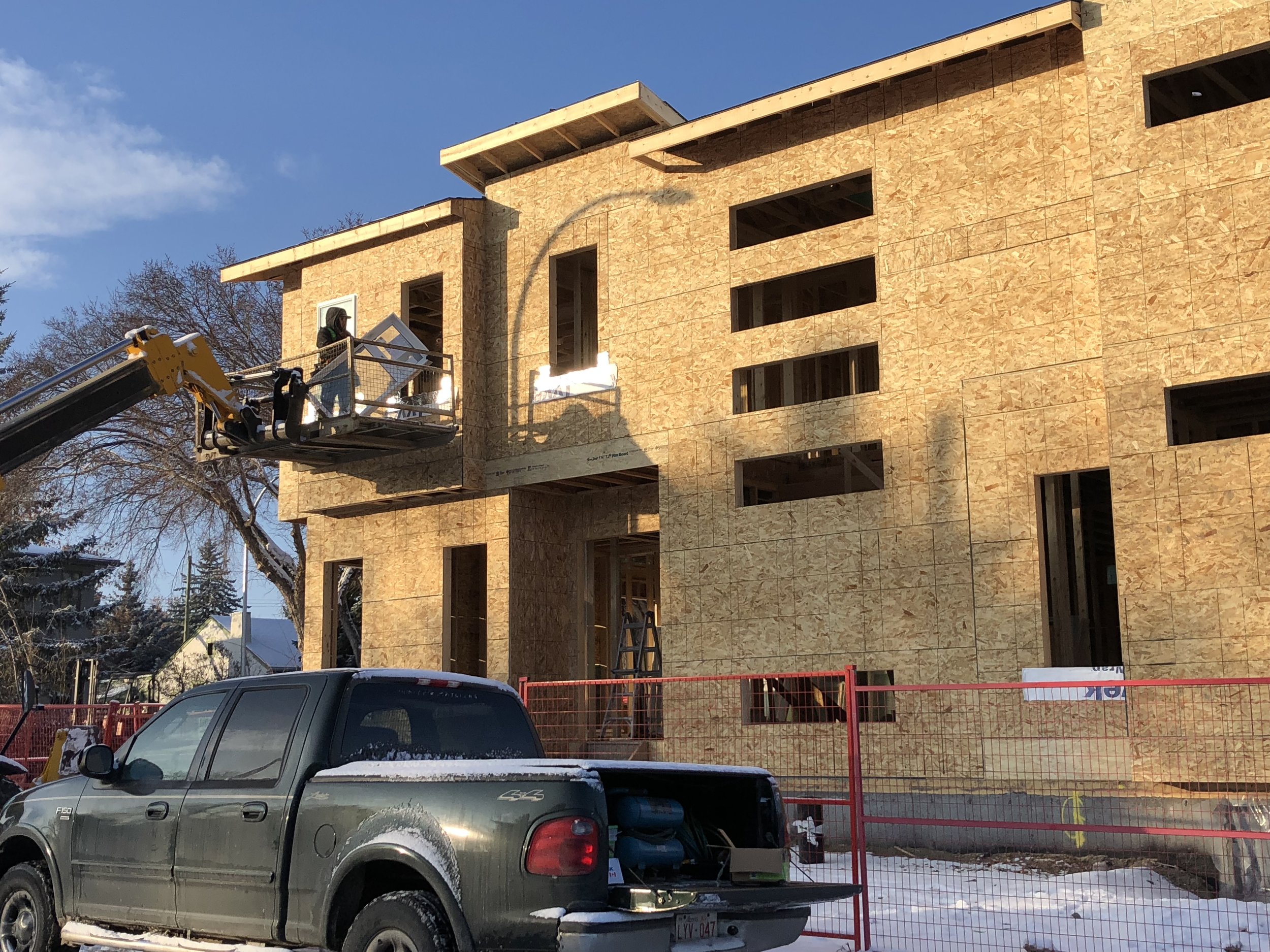
Window install

The framers have the advantage of a man lift with a railed platform on it. That makes window install way easier.   This is the first install I’ve done under the new code with the peel and stick membrane, fortunately my framers seem very familiar.  All the windows should be done tomorrow and we’ve arrived at lockup.  This is a good thing as we can control access a little better.  Some idiot arrived at the site late one night and tried to drill the lock on the framers lock box.  I didn’t realize the kind of person who would do that owned a drill.   Likely they stole the drill from some other job site to continue their life of crime.  There is no shortage of these idiots around the inner city.  The police have no way to deal with these people so we didn’t file a report.   


IMAGE.JPG

The framers have a four wheel drive elevator. The productivity gains here are significant  


this is the peel and stick membrane that is put on the window jamb before the window goes in.  

this is the peel and stick membrane that is put on the window jamb before the window goes in.  

Liberal lies and broken promises related to rental housing

Frequent readers of this page will no doubt be familiar with the regular diatribes against all levels of government incompetence and lies that the good people of Alberta must endure.  The latest example is the broken promise of the liberal government.  The liberals like to grandstand as protectors of the lower economic classes and other such nonsense.  What they really do is just the opposite (i.e the finance minister business dealings).

There is perhaps no better technique to increase the supply of rental housing than to tax it less.  Less tax would make more builders build, and rents would be that much lower to benefit the tenants as supply and competition grow. The liberals know this and used some nicely placed lies to help get themselves elected.  Now they are breaking yet another major promise to remove the gst on rental housing.

Rental housing is a service provided by landlords to tenants.  Yet it is not subject to GST.  However, when built, the feds receive a huge windfall of cash on new rental housing.  On a small building the feds will earn $50-$100k, that is a lot of money.  The landlord will have to recoup that GST over the next few years of rent.  It takes a lot of rent to raise $50k to give to the government.  Rather than collect GST on new rental housing and then waste it on useless initiatives and pensions, perhaps the liberals will reconsider its broken promise and actually do something to help renters live more affordably (I doubt it) like they promised during the last campaign.

Here is the liberal figurehead, and primary broken promises maker.

Here is the liberal figurehead, and primary broken promises maker.

Adverse weather slab pour

We got out the heaters and hundred pound propane tanks.   That is the cheap way of getting the basement heated so we could properly pour the slabs.  Total cost about $200 plus cobbling together some tarps and plastic to cover the windows and stair well which was more work than I’d like it to be.  Fortunately the coop gas bar near Killarney has a propane fill station so tank fills are possible.   


IMAGE.JPG

the slab has cured nicely.  By framing the basements soon we can stay ahead of the trades. I also resent hanging the furnace and trying to pour the slab later.  With the radon sealing rules we don’t want to be doing that.   This way we can be more confident that the radon pipe will be the only significant penetration in the slab. The next job for me is to seal the perimeter with caulking and all the pipe stacks.  Lumber is ordered so we should be having those basements framed soon.  

Window delivery

With windows and shingles on site ready for install we are nearly at lockup stage.  Getting the building snow proof is a huge plus.  Shoveling the inside of the project last year was a lot of work and a waste of effort.  


IMAGE.JPG

Ready to go. Some nice and large windows need to be installed soon. 

Stair install

We ordered two sets of the integrated landing stairs from a really good carpenter.  Not surprisingly they went in well and look great.  It pays to have the guy who installs the railings make the stairs as well. This way he’s compelled to make the stairs in such a way that the railing job will be easier later.  Overall accuracy is improved and the treads and riser dimension will be identical.  


IMAGE.JPG
IMAGE.JPG

Back in business

Now that I have returned from a poorly timed vacation, there is substantial work to tackle.  A lot of progress was made on the semi detached site while I was gone, basically it was fully framed and the basement slabs prepped for the pour.  Thanks to my new manager Cornell for dealing with stuff while I was away.  I've got the schedule revised and a lot of deposits and payments made for the next stages of work.  We are ready to pour the slabs, frame the basements, install the upper stairs, install the windows and load the shingles.  The plumber is on notice to start and the HVAC crew is attending the site to prep it.  That is a lot of stuff for Novemer.  My fourplex DP was irrevocably approved, and my rowhouse basement has started excavation.  So the construction business is looking good.

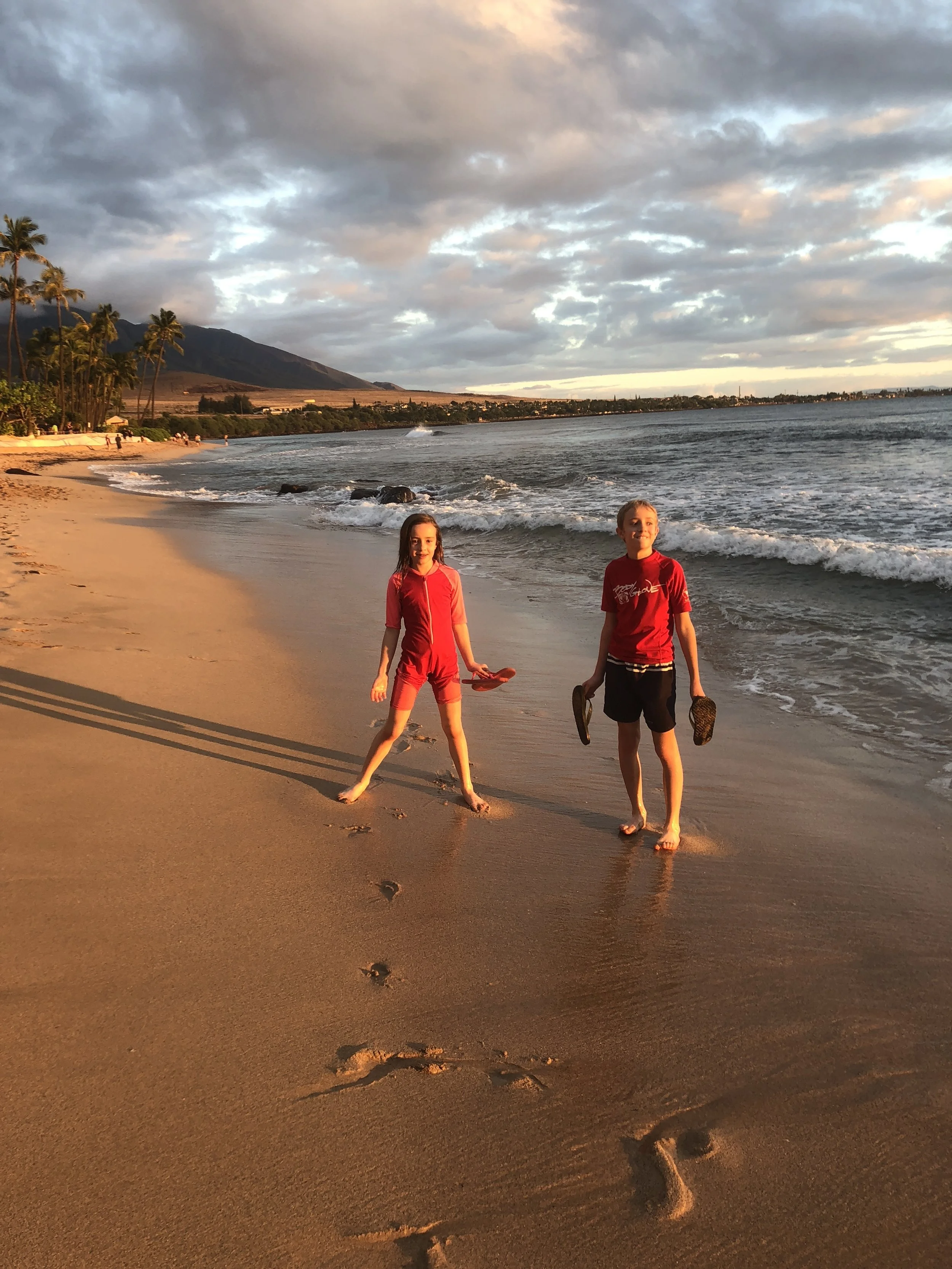
Leaving Calgary is a chance to look at best practices, or just different stuff from other places.  Here is a favourite from Maui.  I'd like to build houses in a place that is always summer.  That'd sure beat the Calgary winter.  Pouring a garage pad in January would make projects here a lot cheaper and more predictable...

Really neat strip mall development near the airport.  Not the mall, the siding.  Where can I get this material? Fortunately my suppliers in Calgary sell something similar.

Really neat strip mall development near the airport.  Not the mall, the siding.  Where can I get this material? Fortunately my suppliers in Calgary sell something similar.

Jeep interior after two weeks of abuse, not the washable floor kind of Jeep either.  The trunk was worse but more easily cleaned out.  Kids found it to be hilarious that they made this much sand mess...

Jeep interior after two weeks of abuse, not the washable floor kind of Jeep either.  The trunk was worse but more easily cleaned out.  Kids found it to be hilarious that they made this much sand mess...

Fourplex development permit is approved

My shaganappi fourplex project has been approved and no appeal was registered.   This is a significant step forward in proving the viability of the project.   

The design work encountered a major hurdle thanks to some irrational exmax requirement for a huge rear setback.   We were feeling squeezed between attempting to be contextual with the 60 year old neighbourhood frontal setback and then we were told the alley had a large setback as well. Without moving the building forward we’d have been left with little buildable footprint. That worst case scenario would be a distaster for a two building fourplex on a56 x 110 ft lot.

Fortunately the planning staff came through with some very progressive thinking and we relaxed the front setback.  I also met with the neighbours to gain support for the relaxation and this actually worked out better than I had hoped.  This all unfolded over a year long process.  It could have been quicker but for reasons I’m going to forget about we needed all this time to get to the finish line. One of my builder friends describes this process as a form of brain damage.  I’ve heard the process described elsewhere similarly (and it is much worse in Portland Oregon, a jurisdiction I find endlessly amusing for its hideous infill policies). This fourplex was much less brain damaging than other similar processes I’ve endured. For example the row house process was vastly worse. I’m still recovering from the row house project brain damage.  I’ve yet to determine if the brain damage accumulates or dissipates over time.    

This ends my development permitting for 2017 and possibly next year too. I’m currently too broke to be buying more land.  Ideally I will take a huge break from permitting once this fourplex has a bp and of course the dssp remains. This is going to be another storm water adventure as I struggle to contain the costs.   This project is on the back burner for now, I’ve got to get some building done and a few houses sold before I start a new one.


IMG_0310.PNG
IMG_0309.PNG

No appeal on the fourplex. What a relief.   

Roof install

The framers are getting the roof installed, this allows us to plan some of the next trades.  Windows, shingles, and basement slab pour will get us to the lockup stage.  


IMG_0306.JPG

Radiant heat - basement slab

The basement plumbing passed and the plumber returned to install the network of pipes on the insulation.  Once finished, the circulation of hot water inside the slab will make for a very warm and comfortable basement living area.  finishing the radiant heating system in the basement remains a costly endeavour.  It is a supplementary system to the forced air furnace, thus is totally optional to do.  Like many other materials that go into the job, cost has give up.   It will be interesting to compare the price of these systems with the one I did on my house in 2014.  


IMG_0299.JPG

Framing progress

The semi detached framing project is proceeding nicely. If the roof can go on next week we will be nearing the lockup stage.  Shoveling inside the house is never fun so ideally we won’t need to (again).  


IMG_0216.JPG

Second floor walls are almost up.   

More cynical commentary from your builder - the Banker edition

In my experience these bankers are all alike.  It is so hard to get any money from them and recently the risk threshold of the banks has ratcheted lower.  They constantly ask for more and documentation, personal guarantees, and drag out an application process that is doomed to fail.  This is making it nearly impossible to finance excellent projects (like mine).  My projects that get rejected would actually be successful and lead to repayment.  However, due to the scale and fees involved, the bankers are suckers for the bigger operators.  The banks would prefer to make one 100 million dollar loan rather than 100 one million dollar loans.  The route of this seems to be the banking system is lazy and smaller businesses are frowned upon by internal policies.  

Every once in a while these big loans go sour.  Today’s jackass award goes to royal bank.  Let’s hope they lose their shirt on this massive loan and maybe reconsider making some smaller loans to small builders ( that’d actually be paid back rather than defaulted on).  


IMG_0211.PNG

how much of the 64 million dollars will royal bank get back?  Hopefully they lose enough to maybe consider offering small builders loans.   

Dumb government = dumb policies

the province finally got around to its latest confiscation scheme - builder licensing.   This useless and wasteful program will be yet another anti business program put in place to take money and offer nothing in return except a false sense of security that the government is going to take care of you. 

Here is the latest salvo in its relentless scope and fee creeping scheme to extract more money from the productive minority of society and transfer it to those with defined benefit pensions.   


IMG_0210.PNG

Starting five houses and leaving town anyway

One of the advantages of house building is the control the owner may experience over the build schedule.   This allows the builder to skip town at any time for any reason. Of course what really happens is the vacation is booked months in advance and once the departure is imminent, project delays that were totally unpredictable render the timing to be terrible.  This is how I find myself starting five houses and leaving anyway. 

While some work can’t proceed without the builder to supervise, a lot can.  Let’s hope we see some meaningful progress at the semi and the row house is excavated when I return.  


IMG_0176.JPG

Multi-part series the DSSP - final edition

It is always a relief when the DSSP related work is done on site.  Now the unfortunate task begins of tallying up the final ‘score’.  It is hard to attribute the cost as any kind of a victory, despite how difficult it has been and how much time and attention has been lavished on the work.  In terms of construction expenditure vs. value of work done, the DSSP costs are a real loser compared to other tasks like say, installing a kitchen.  I am publishing my final costs here, normally I would not do this but I’m so aggravated by dssp wastage that I don’t mind posting some of the uglier numbers.  

Design - engineering related cost is approximately $4500

Fees - the various fees here added up to about $8000, much of it for asphalt degradation on the Killarney roads (storm component only), plus the DSSP review fees and the frontage fee for storm water.  The offsite levy for downstream infrastructure is not included here because it is for water treatment that is needed on every job.  So I haven’t included $9000 of other fees.

Indirect or intangible cost - while this is harder to quantify, I had to redesign the roof such that the storm water could be managed in a realistic fashion by having all the water shed from the roof into the sideyard.  This has other implications for building the structure, all negative. I'm sort of guessing here that the changes will cost about $10,000 vs the preferable roof design I had originally budgeted.

Install - this is an easy number to calculate, the storm component was about $26000, the remainder of the cost was the regular sewer and water install that all projects require, these days that other part is $20000.  So the regular cost isn’t part of the dssp final total.

Surveying - more specialty work here to locate the components of the project.  $1750.

Delays caused by DSSP complexity - the DSSP was designed promptly and massaged through the various City checkpoints early and well by my civil engineering contractor.  The delay was caused by my inability to commit to the site work until I had the development permit approved, and the BP at least in progress enough that I could commit to starting work.  This added about three months of very aggravating waiting that burnt up much of the summer and fall building seasons.  While no number can be placed on this delay, the time value is more than $10000. The delay of losing the summer season and the difficulty in doing the concrete work is a major cost I have not factored in. 

Management - we are going to apply a value of $0 for the management and financing of the project, mainly because the company owner works very very cheaply, and has bags of low cost money to spend on these DSSP installs, and vast amounts of free time to invest in overseeing the engineering and contracting of civil works.

So, adding it all up, we get to $60250 to create about 10 m3 of stormwater storage and interconnect it into the City system, pay everyone involved and send a bunch of money to the City to be carefully spent by the administration on wages and pensions.  

There is a lot of financial waste in building, so that often it seems like you are just burning money in order to comply with the various rules and policies that are in place.  Our city isn’t known for assessing the cost benefit ratio of polici…

There is a lot of financial waste in building, so that often it seems like you are just burning money in order to comply with the various rules and policies that are in place.  Our city isn’t known for assessing the cost benefit ratio of policies that are hard to comply with.  I’m finding the dssp is an example of high cost for little societal value.  I’m convinced that $6000 for a cubic metre of storm water capture is crazy.  


Progress at the Killarney semi-detached project

With backfill complete and a load of lumber dropped off, the framers were able to come by and begin the process of installing the main floor subfloor.  This is a fast crew and I have wanted to try them since I observed them working for a few other builders.  The house should be framed in about 4 weeks.  I've made this bold statement in the past a few times, so we will soon find out if my prediction is accurate.  Working on the semi-d is a welcome relief from all the underground work underway at the row house project.  The nice feature of these two projects is they are in the same community and only about seven blocks apart making for easy commuting.

Framing is off to a nice start at the semi-d, next week we could see some walls.

Framing is off to a nice start at the semi-d, next week we could see some walls.

Multi-part series the DSSP 10.0

Final install day contained some challenges. First the trench for the pipe connecting the third manhole to the second manhole was not easy to dig due to space constraints, and the new machine malfunctioned, necessitating the delivery of another machine.  Fortunately the contractor has this much capability that swapping out six figure machines is routine for them.

Here we have the final manhole in place right on the side property line, and connected in a bed of gravel downstream too the middle manhole.  Then we have the broken machine getting repaired and the new machine arriving which cost much of the afternoon to be lost while the repair guy attempted to fix the problem.  Fortunately the work is now complete and we can move on to the next stage of the project.


Multi-part series the DSSP 9.0

The onsite work has now really begun.  This stage is an interconnection of manholes within the front yard, and down the entire sideyard to a third manhole.  All of this adds a lot of unnecessary cost and waste given the amount of storage that is created (next to nil), yet complying with the drawing is essential so we must carry on.

This manhole shows the 12 inch line entering from the street.  The 3 inch pipe is for sump water that is collected in the basement.  I am still puzzled as to why this is allowed to enter the City system unimpeded after the flow restrictor …

This manhole shows the 12 inch line entering from the street.  The 3 inch pipe is for sump water that is collected in the basement.  I am still puzzled as to why this is allowed to enter the City system unimpeded after the flow restrictor which is in the manhole.  


The second manhole is installed in the background.  The pipe connecting the manholes crosses over the water and sewer lines that were installed earlier.  

The second manhole is installed in the background.  The pipe connecting the manholes crosses over the water and sewer lines that were installed earlier.  

Tomorrow the project is due to be completed and we can fill it all back in and get ready to dig up the rest of the lot where the basement goes.  This is going to be a challenge now that the formerly empty site is somewhat loaded with storm catchment equipment.  

Multi-part series the DSSP 8.0

With the sewer and water component largely wrapped up and the trench backfilled, the crew has moved onto the storm water connection.  This is the element of the project that has been so difficult to manage, primarily because the shallowness of the city main.  Imagine a concrete storm sewer below the road, and it is filled by surface water from gravity drainage.  Now, with a City requirement to actually store the rainwater on your property, you would naturally want to stick a big manhole into the ground, and connect it to the main.  This requires some slope, and some depth.  Both of which we don't have here.

The storm water main is about the depth of a shovel from the road surface.  This is causing a lot of storage issues upstream.  

The storm water main is about the depth of a shovel from the road surface.  This is causing a lot of storage issues upstream.  

The 12 inch plastic pipe is the connection to the City storm main.  Coring through this really old hardened concrete was exceptionally difficult. The outside diameter of the pipe is very large and the bit needed to cut concrete is undoubtedly v…

The 12 inch plastic pipe is the connection to the City storm main.  Coring through this really old hardened concrete was exceptionally difficult. The outside diameter of the pipe is very large and the bit needed to cut concrete is undoubtedly very costly.  I never saw it done or would have taken a photo.


The truck with the concrete vessels arrives on site.  Now we see the implication of the shallow City connection.  We have to also use really shallow  and short manholes.  In order to gravity drain, the bottom of our storage has to be higher than the storm main, plus some slope for the pipe.  

Everything on the truck is used for storing rain water from the building so that it does not overload the City infrastructure with water in a flood event.  The idea is the water backs up into the concrete vessels and pipes connecting them, and …

Everything on the truck is used for storing rain water from the building so that it does not overload the City infrastructure with water in a flood event.  The idea is the water backs up into the concrete vessels and pipes connecting them, and even into the landscaped areas and slowly trickles out.

The problem with this idea, of storing water on site so it slowly releases downstream (eventually into the Bow River), is the cost benefit analysis hasn't been done.  The cost of these tiny installs on each project is inefficient, due to the custom nature, engineering requirement for the design, the City fees for reviews and change, the inspections, etc.  It doesnt make any sense to do it this way because the volume of actual storage created per cubic meter is so low vs the cost per cubic meter of installing it.  Of course the City doesnt care about these issues because it has no concern for the well-being of small business owners like home builders.  Every time the City changes the rules on these DSSP installs, it increases storage requirement and decreases outlet flow rate.  Eventually the install becomes impossible, or so onerous, when combined with unworkable elements like shallow mains, that the cost will be enough to wipe out the project economics.  Again, the City doesn't know or care about these realities.  When the City does projects of its own, it has no budget constraints for DSSP, and it will just pay whatever it takes to solve a compliance challenge.  Builders tend to have a lot less budget for compliance matters that customers don't appreciate than the City departments.