Cynical commentary on blinds courtesy of your builder

One of the odd and puzzling features of new home building is the relative cost between windows, and window coverings.

Right away you can conclude one thing, windows are a reasonably priced, essential component of the home and provide tremendous value to the occupant.  Window coverings, well, these are fairly useful, they block out the summer sun and offer privacy on demand.  But the price of window coverings is atrocious.  

Relative to windows, the coverings themselves cost about the same as the window.  The widow manufacturer has a huge operation, delivery trucks, has to manufacture and assemble glass sealed units with low energy coating and costly gasses inside the sealed units. The window covering company just needs to assemble some fabric and plastic and hang it from the window frame.  There are no codes for window coverings that are remotely comparable to what a window manufacturer needs to comply with.  The window covering does not get exposed to harsh weather, or have to seal the interior of a home against the elements.  

One must wonder how this has come to be.  I think it is because the blinds companies have tremendous markup on the products, and somehow have convinced the buyer of a new house that the blinds are worthy of such a large investment.  I'm all in favour of blinds purchases, however I will be looking for some major discounts next time I try and source some window coverings, especially since I know how much the windows cost!

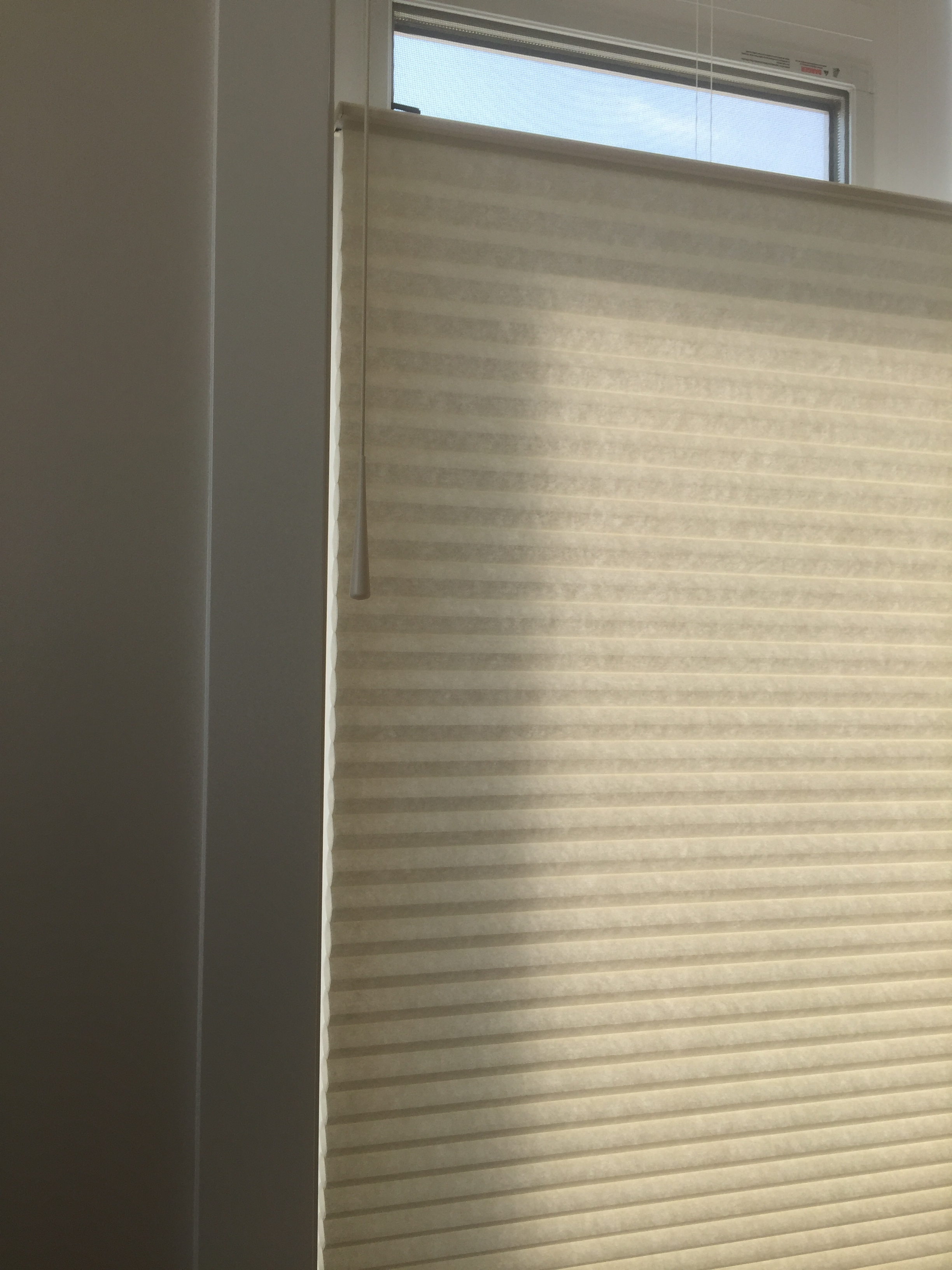
Here are some really nice blinds!

Here are some really nice blinds!

Why is the City so incapable of fairly appraising property for the purpose of taxation?

Today we are going to show another example of how the chronically cash strapped City of Calgary is leaving millions of dollars of annual revenue on the table each year.  I am going to suggest a number of reasons why this is the way it is, and propose some possible solutions.  

First, the issue is one of equitable distribution of property taxes so the City can provide the services it deems necessary.  Council is required for political reasons to hold property taxes low, and has over the years done a reasonable job of this.  However,  I have noted some trends in inner city taxation in the area I know best, so we can just look at Killarney for the specifics.

  • Taxes for long term owners of property are much lower than for buyers of new housing vs the true value of the properties (City appraisals are way off for older property)
  • Taxes for larger bungalows on 50 ft lots are often much lower, possibly thousands of dollars lower annually than they would be if values were accurately appraised
  • The property owners that have enjoyed the greatest uplift in land values often bear the smallest share of the property tax bill, yet are the most able, due to large equity gain in the home, pay more taxes vs heavily indebted new buyers 
  • Families with children that purchase new homes appear to be taxed the most heavily while those that have enjoyed decades of quality living in great communities pay the least tax on property.
  • Rebuilding infrastructure does not seem to be paid for by those who have lived in homes the longest, yet is disproportionately paid for by new buyers by the large new City fees like the off-site levy.

The City has advanced techniques to track and adjust property tax levels on individual sites, and quickly adjusts values upwards when it chooses to do so.  I have had properties under construction or recently completed be hit with immediate and major tax increases.  This is puzzling when older properties see little annual assessment changes despite large valuation changes.

I have come to believe the reason for this is the City wants to avoid antagonizing older, possibly senior, and likely vocal complainers with politically incorrect tax hikes. It does not want to be seen as the Council that oversaw massive takes hikes to 'vulnerable' seniors, pensioners, those on fixed incomes, etc.  The issue seems to one of optics rather than equitable sharing of tax.

Here is an example of a massively undertaxed home in Killarney, valued by the City at only $535k. 

I met the owner of the property.  He and I had a long discussion about the community.  He mentioned he had bought the place 20 years earlier for about $180k, had little interest in moving, and often spent his retirement at his cottage in BC.  This doesn't sound like the prototype of a senior hurting for cash.  For this property, I have estimated the tax at $3475, and I believe it should be raised, along with the assessment, to an annual tax rate of $4870, an annual increate of $1395.  This is just one of many examples of older homes being massively undercharged for taxes.

This is a cut and paste of how the City assesses property tax.

Property assessment is a value placed on a property for municipal and provincial taxation purposes. The City of Calgary assesses each property annually to distribute fair and equitable taxation. The estimated value of each property comes from the measurement, analysis and interpretation of the real estate market and is governed by the Municipal Government Act. This process is based on mass appraisal models that are an expression of how supply and demand factors interact in the real estate market.

How properties are assessed 

Your annual property assessment reflects the estimated market value (the amount it likely would have sold for on the open market) of your property based on the valuation date of July 1 of the previous year, as set by the Municipal Government Act. Real estate market conditions may change from the valuation date to when you receive your current assessment. Market changes that have occurred since July 1 of the previous year will be reflected on the following year’s assessment. Following the assessment notice mailing, there is a 60-day Customer Review Period  in which you are able to contact us with any questions you have. 

To determine market value, we use one of three approaches to value:

  • Sales comparison: comparing to sales of similar properties
  • Income: capitalize the income being generated by the property
  • Cost: land value, plus the depreciated replacement cost of the improvement

END

If the City was actually assessing property accurately there would be equitable distribution of taxation.  What we have now is a very skewed situation where older houses are under assessed, and newer houses are accurately assessed.  I will revisit the property highlighted above and see if favourable market conditions over the past year have resulted in more accurate appraisals on these older homes (I doubt it).

Rather than taxing long term residents who have enjoyed a massive windfall in property value, the City like to charge builders and new buyers more.  Builders are an easy target because they are a group that nobody really likes, is fairly small, and would garner little sympathy from the public when discussing taxation rates, and even if all the builders in the City voted, it would have zero impact on an election.

New buyers are an easy target too, because if someone can afford to pay the high cost of inner city housing, then surely they can pay more tax than the neighbour who's lived there for thirty years.  New buyers have less justification to complain about tax because they could choose to not buy the house.  Long term residents seem to get a tax discount by the City because they could possibly be forced to move if taxation was too high (I don't think this is true, but again, it is optics not reality that matters).

My solution to this issue is fairly simple, first the tax system needs to change to better reflect use of expensive infrastructure, and congestion fees on roads such as Deerfoot and Glenmore would be a fine place to start.  Second, inner city areas need more accurate appraisals.  Third, inner city areas should get some discount vs outlying areas that have huge needs for police stations, fire halls, roads, arenas and schools, so this would soften any impact of accurate appraisals on long time home owners.  I do realize this will never happen, so perhaps this is a completely pointless discussion.    

END

House value = scrap - asbestos - demolition

Surprisingly little of the homes built in the postwar Killarney bungalow era of the 50's and into the 60's and 70's is worth salvaging today.  I removed all the old growth 12 inch fir planks off a recent house I was prepping for demo and today I salavaged the copper water lines that were conveniently exposed in the basement ceiling.  I have a new formula for the value of these older homes.  The house structure is worth a negative number, to arrive at that figure, subtract what you can take out of it in salvage, subtract the asbestos related fees, and then the demolition.  By the end of that equation the house is likely worth a negative $15k.  That suggests the property would be worth more vacant than with the house still standing. 


This is all the copper recovered from the Killarney house.  

This is all the copper recovered from the Killarney house.  

IMG_4846.JPG

68 pounds of copper earned me $166.   

That was a reasonable amount of labour to collect $166 of copper pipe.  Perhaps about three hours total plus drop off at the scrap metal shop.  Unfortunately the copper is all I have determined to be worth saving, the rest of the house is nasty. The house will go to the dump and be very expensive to dispose. Even worse will be if we find asbestos in the drywall and flooring.   

Collecting the valuable copper pipe was the good news, likely the demolition and asbestos fees will be an additional $10k, and possibly a lot more.  Next time I buy a house I'd like the seller to take it with them and just leave me the land!  

Final photos

With the completion of our final of two homes on the 41st project, I was able to have the photographer return and take some pictures. The staircase is a highlight of the project, and many favourable comments were received.

We couldn't have a show home or open house on this project, partly due to time constraints, and partly because my houses are selling too quickly and they tend to be sold while they are unfinished.  Instead of an open house, I will post some photos to my website on the semi-detached page, and here.

RCG viability in the mid block

EDIT - this is old information and out of date. Mid block Rcg rules are changed as of 2022. These changes enable more development options in mid block locations.

The City experiment with the rowhouse zone continues.  I think the planners are getting some negative feedback from the builders.  I think the planners should have asked the builders before they went ahead and created the rules for the zone, because I doubt planners have a sense of marketability of homes.

The problem with RCG mid block lots is it only really allows super skinny stuff to be built, and the builders wont build that because they are paranoid, justifiably, that nobody will buy 14 ft wide townhouses.

It just so happens that 50ft multiples of land are not wide enough for three units, and 100 ft of land is no better for 6 units.  To a builder, building 6 unsellable units is a major blunder.  There are other zones that would allow a 100 ft mid block parcel to create 8 really good units, rather than 6 really skinny ones.

One of my favourite builders, rndsqr, has created a diagram showing this problem and presented it to the Calgary Planning Commission.  I have pasted in the diagram here.   Thanks rndsqr for putting forth such a sensible position.

This diagram shows how 6 skinny units wont work in a 100 ft parcel, but 8 units arranged differently would be great.  It also highlights how on 100 ft, if a corner is accessible, the 8 units can be achieved.  rndsqr has built that layout i…

This diagram shows how 6 skinny units wont work in a 100 ft parcel, but 8 units arranged differently would be great.  It also highlights how on 100 ft, if a corner is accessible, the 8 units can be achieved.  rndsqr has built that layout in the NW on 20 ave, designed by intertia. rndsqr and I are sharing intertia for design work on these projects.  I am getting so tired of rcg related matters I am contemplating quitting townhouse building and pursuing simpler semi detached projects.  I have two townhouse projects to build in my inventory, and these may be the last.

Another RCG application in a prized Killarney location 2240 26a St SW.

Today as I was making my way over to the house I purchased at 26a st and 25 avenue, I noticed one block to the north the owner is attempting to re-designate the lot from Rc2 to RCG.  Will the rowhouse, the inner city bogeyman rear its head, and will a horde of angry NIMBY types descend on City Hall at the 2018 meeting with the tears and hyperbole of how the row house will destroy lives?

This will be an interesting test case for the next Council to deal with.  I am really shy of attempting any more RCG projects, the time and trouble is just too great given the range of potential outcomes.  The last similar application did not even reach the vote, a motion to quit was passed before the vote could be read and only the Mayor and Councillor GC opposed.  

My advice to this applicant (if they had asked me, but they didn't), would have been to not waste the time and expense on this location.  I see it as a low likelihood of passing, with a strong likelihood of costing a lot of money and time.

This is the project location.  It is a great place to build a rowhouse project in Killarney, but will it be allowed?  I guess no, but we will find out next year.

This is the project location.  It is a great place to build a rowhouse project in Killarney, but will it be allowed?  I guess no, but we will find out next year.

Air Conditioning

As the heat wave has continues, it is a nice opportunity to make use of the air conditioner at the 41 st project.  Today the install was finished and the equipment tuned and calibrated.  It works great!  Given the remarkably low electricity prices, AC is a pretty low cost to operate in Calgary for the summer months.  


This is where the cooling happens as the phase change of the coolant liquid removes the heat from the building and pumps it outside to be blown away at the compressor.  

This is where the cooling happens as the phase change of the coolant liquid removes the heat from the building and pumps it outside to be blown away at the compressor.  

Affordable housing - not here

I have posted frequently in the past how this City (mostly the administration by my best guess), does not want affordable housing built in Calgary (despite what the leadership says).  The prime directive of the organization is to take as much money as possible from builder applicants while ratcheting upward costly requirements, it does this to feed itself enhanced benefits, wages and pensions, and authority over the productive class of the economy.  The latest trend is increasing professional involvement and more code requirements.  Having more professional involvement in my view has a few repercussions.  It layers on more complexity and time, and the outcome is rarely different other than more payments are made to the professionals involved.  The City loves increasing professional involvement because it makes for a convenient location to point a finger at if something goes wrong.  For the City, it is most satisfied when it can take fees, enforce unnecessary regulations, and pass off liability to a credentialed third party.  Professionals can justify their fees by taking on project risk that was not formerly there.  The outcome is always more cost, and in the end, everyone has to pay.

The amount of Orwellian double speak is fascinating in the building industry today.  We have the Alberta New Home Buyer Protection Act, which is legislation that does little to improve housing and mainly transfers resources from builder construction budgets to insurance companies, and we have municipalities that use internal policies to undermine the Provincial Act.  In Calgary, the trend is to create two new rules or fee based policies for every outdated regulation that is deleted.  New publicly funded housing projects are celebrated with ribbon cutting ceremonies, while policies are put in place to make every other housing project more costly.  

A classic example I have found about how the City makes costs higher is by ensuring that there can be no warranty premium exemption given to builder/owners who intend to build market based rental housing.  The Provincial Act has an exemption to qualifying projects so that the builder doesnt need to pay warranty premiums for new rental buildings (why would you pay for the warranty that you have to service yourself?).  The City ensures that permits are not given until the warranty exemption is impossible to achieve by undermining the Provincial Act.  Rarely do you see a written example of a municipality directly putting in place an insubordinate policy.


Section of Alberta New Home Buyer Protection Act:

I understand that Pursuant to Section 3.1(8) of the Act, when this designation is registered on the certificate of title to the Lands, the lands may not be:

  1. Sold, made subject to an agreement for sale or otherwise disposed of, unless it is sold to a person referred to in Section 3.1(3) of the Act.
  2. Included in a condominium plan or a proposed condominium plan, or
  3. Subdivided in any other manner, during the protection period applicable to the multiple family dwelling(s) under Section 1.1 of the Act without the written permission of the Registry.

I agree and understand that the Registrar will register a Caveat against the rental property for the duration of the protection period. Upon expiry of the protection period, the Registrar will discharge the Caveat from the rental property.

How the City of Calgary undermines this section of the Act:

  • Development Permit will not be issued until the proposed condo plan is submitted for the project.


Modern font house numbers

House numbers are tricky to find even in this era of online shopping and google searching.   The hardware stores sell the same crap they always have and refuse to explore what could be a lucrative market of making nicer product available. I have a new supplier of numbers and they have great sizes and fonts available.  Soon we find out how well they install or if the house builder is competent at putting up striaght numbers. 


IMG_4792.JPG

These look pretty easy to install but getting them on straight is the challenge.  

Stair glass install

The last components are being installed at the semi detached project.  We have some lighting to deal with and the glass for the stairs.  The glass panels are hung off of clips that screw to the wall and post anchor points.  Once we do this we can pass the inspections and occupancy will be granted.  


IMG_4784.JPG

first the clips 

IMG_4787.JPG

and the glass goes in.  

Insane NIMBYism and the Rowhouse bogeyman

Further  interesting NIMBYism from Calgarians claiming not to be NIMBY'ists.  What is amusing about this submission is the nearly hysterical bias against an urban form (the rowhouse).  I will add some of my own thoughts in the text below.  The bold parts are pasted directly from a public submission to council.

We don't want to be the people who say "NOT IN MY BACKYARD" but our area seems to be inundated with projects that would not be accepted any place else.

This is total nonsense.  this community does not have any exceptional level of development vs. any other inner city community.

 A drug rehab apartment building on 1th Avenue was opened. We don't feel safe walking in our own neighbourhood. On the corner of 1th Avenue and 13th Street a developer got permission to bring in a modular home and stack 2 on top of each other and finished it with galvanized steel. This would not be allowed in any new community. It gets worse. On 17th Avenue an infill is finished with old barnboards.

 Now barn boards and corrugated siding is the enemy?  This type of exterior is allowed anywhere an applicant chooses to submit a plan containing those materials.  I guess this person thinks they should control what everyone else does on their property as some sort of architectural overlord?  Isn't this the definition of a NIMBY?  Do we want the zoning bylaw to try and regulate everything including design taste?

Would you like to live next to any of these? It seems any project that would not be accepted in any other neighbourhood is allowed to be built here. We know the city wants higher density and we are already complying with this through infills and duplexes.

Duplex development has been allowed for decades.  Building duplexes isn't adding any density, it is just changing from tiny bungalows to what the area was originally planned for, but at the time duplex development wasn't needed because land was so cheap.  These are the same future property sellers that will try and squeeze every dollar out of the transaction when they eventually sell.  Maybe they will give me a discount if I buy their house and agree to put on a tiny bungalow?

Why are the people who bought here 20, 30, 40, 50 years ago and made the community what it is being penalized for making this community a place where everyone wants to live. We already have projects we don't want that take away from our community spirit and we don't need Row Housing to make the situation worse.

Apparently new building in the community you live in is a penalty and will transition it from a place everyone wants to live to a place nobody wants to live (except all the new people that move in to the new houses).  If you live somewhere for 20-50 years you should be able to lock in outdated land uses just because of your own personal bias.  You deserve credit for making a place what it is (what did you actually do other than live in a house that you purchased for a very low price?).  Row housing is going to destroy the fabric of this community - once again the row house is somehow the greatest urban villain.

Anyone who morally or ethically agrees to these changes and votes for it should consider putting Row Housing on the lot next to them and not next to us!!!

 OK so now the NIMBYism is really coming out.  What this NIMBY couple really wants is row houses to be built next to the Council members homes, not next door.  This couple approves of adding density in the inner city, just next to someone else...  

REGARDING 1239 19 Av. N.W From R-C2 To R-CG

Very much opposed

Yours truly

Allan and Linda Kopp

Summer slow down

We haven't got been issued building permits to start work on the next two projects, so it looks like a summer slowdown is in order.  Why I can't have this permit lag in January rather than July has been very frustrating.  Warm construction weather in calgary is a precious commodity that I am currently squandering while dealing with the paperwork issues.  The threeplex has been particularly difficult and slow to progress.  The plan remains to get the concrete work for both projects done with plenty of warm weather to spare.


IMG_4771.JPG

a flock of pelicans relaxing on a gravel bar, late summer evening, Bow River SE Calgary near Cranston.  

House #2 update

With the recent sale of our final house at the 41st location, I am now finalizing the interior, and getting the cleaning marathon underway.  The cleaning is a major task and either takes a lot of hands or a lot of hours.  We aren't as busy right now as last month, so I am electing to attempt to clean the interior more thoroughly at a slower pace.  

Vacuuming tends to come at the end, so this basement must be clean.

Vacuuming tends to come at the end, so this basement must be clean.

With the paint finished (other than inevitable touchups), we can plate the walls.  Just a few more jobs to be done and this houses is finished.  Next up is glass railing material (hopefully - still waiting on the clamps).  

With the paint finished (other than inevitable touchups), we can plate the walls.  Just a few more jobs to be done and this houses is finished.  Next up is glass railing material (hopefully - still waiting on the clamps).  

Most Valuable Tree - update

Builder Max has sent us evidence of a more valuable city owned tree than we have on record.  He currently is the leader in our unofficial competition of who is building closest to the most expensive tree.

Here is the first tree we have seen to break the $25k mark.  

Here is the first tree we have seen to break the $25k mark.  

Multi-part Series the DSSP 5.0 - SVHV by John Meunier

Once the DSSP is designed and approved by the City department that regulates the storm water, the builder will get the bad news that he needs to specify the SVHV, or the hyrdrovex regulator.  This is a proprietary instrument, and used to be made in Quebec by http://www.johnmeunier.com, this company has now been sold and is called http://www.veoliawatertechnologies.ca/en/

For a video on what this looks like, click on https://www.youtube.com/watch?v=giEpL3uBkZY

I am guessing that John Meunier extracted a lot of money from the builders over the years, and happily retired himself by selling his company to a big operation.  No doubt the corporate entity that bought out old John has since jacked the price of the valve even more.  I wouldn't know the actual price right now because I have not specified any since 2015.  

How I undermined John Meunier - The last time I was building a project with a DSSP (2015), I was discussing how overpriced all of the supplies were with my install contractor, at the time I was using a certain excavator with a lot of contacts in the industry. He said he knew of a bankruptcy sale where I could get my hands on a few SVHV's for a good price.  I went to the wholesaler, and I bought three of these items, for about $1000.  At the time they were selling for more than $1500, so I was happy to buy a few and store them for later use. 

This is what one looks like 

This is what one looks like 

The vortex regulation effect of the SVHV

The vortex regulation effect of the SVHV

This section drawing shows the SVHV at work, allowing water to flow into the storm sewer

This section drawing shows the SVHV at work, allowing water to flow into the storm sewer

The problem with this device is the City started specifying them but there was only one supplier.  This is typical of the City, it doesn't care about how much the consequences of its  decision that it enforces will cost the builder.  Enjoying his monopoly power, John Meinuer, or, as spell check likes to auto correct to, John Meany, was making a lot of money on these items.  I have since learned there is a different flow restricting product on the market now that is much cheaper, so, I can officially say, John Meany, you can kiss my ass, you won't be getting any more money from me..  


Multi-part Series the DSSP 4.0 - Math is Hard

The reason we hire the civil engineer on this task is not only to draft up a sensible plan, but to do the math to show the City that what we are planning is not completely bogus.  I have taken a snapshot of the actual calculation page in this, and it shows the real black box type work that goes on in these jobs.

What we need to know from this is mostly contained at the end. First, we want to prove a storage volume, which we do at 12.63 m3.  This is a lot of storage, and is a combination of the manholes, surface pond and the interior of the pipes that would be filled with water during a flood event where water backs up from the outflow restrictor all the way to the surface.  We also want to know the post development flow rate off site, that is 32.33L/s/ha, note that we have far less than a hectare of property, so our flow is a fraction of 32 L/s.    The rest of the material, like the Manning's formula, coefficient of slop and absorption of the landscaping is stuff I have not researched, but does play a role in the final calculation (or at least the engineer stamps this drawing and he knows best).

 Another key piece of information to gain from this is we also need to put on a flow restriction device.  While we may have a six or eight inch outlet pipe, we constrict that down using a special valve at our property line.  I will feature this device in an upcoming post.  Constricting an 8 inch pipe down to a fraction of that, just to have it open back up to 8 inch capacity has always been a confounding issue to me. Why not just use a 2-3 inch outflow diameter?  In the event of some catastrophe the outflow restrictor will just exacerbate the problem of moving water downstream.  During the devastating flood of 2013, did anyone demand nature somehow restrict its flow?  Despite this and other storm water storage dilemmas, we do our best to comply and cut cost where possible (these days hardly anywhere).  I plan to install this system this summer at the threeplex, and further break down the cost of this project once we have selected the contractor     

Multi-part Series the DSSP 3.0

The next page of our DSSP shows the grading plan.  This is more about movement along the surface for the storm water.  I have labelled the key elements of the plan in red type. Basically we are placing manholes at the corners of the property, and connecting them with a combination of pipe and surface swales. At the final manhole, we are going to create a concrete surface box that could act as a retention pond in the event of a flood.  The pond would drain back into the last manhole, and finally out into the storm sewer.  

The idea is that these catchment basins will slow the initial flood of water into the storm system, and delay its arrival that bow river which is downstream of this community.  Eavestroughs must be pointed toward the manholes so that the water off the roof will not exit the site in an uncontrolled manner.  In combination with soft surface landscaping, the new project should not have an impact on storm system capacity.  It is fairly obvious that these systems are complex and expensive to install, and the City policy is what determines outflow rate at the end of the pipe.  This is where it can get really difficult to comply. 

This is the slightly edited grading page, where the flows are labeled with directional arrow and the surface pond is identified.

This is the slightly edited grading page, where the flows are labeled with directional arrow and the surface pond is identified.

Multi-part Series the DSSP 2.0

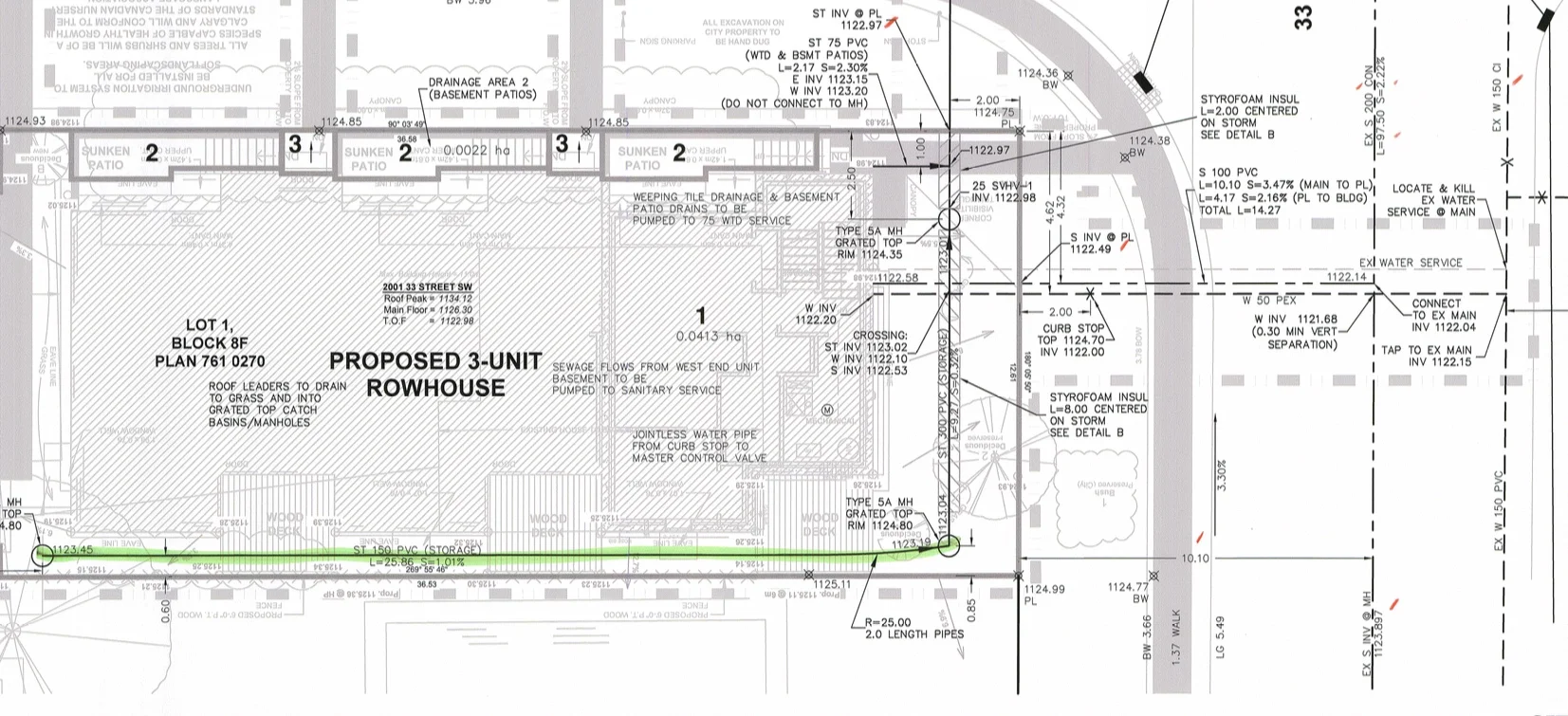
The first part of our DSSP is the Site Utilities page.  On this you have the property, the building, the water and sewer entering the building from the street, storage vessels, and connection details.  All of this is scaled and marked with elevations such as TOP 1124.7  and INV 1123.19.  There is a lot of engineering notes, fairly jargony, related to weeping tile, manholes, dimensions and slopes.

The idea here is the water is contained, and channeled, and flows in the right direction to leave the property.  The mechanical room is shown and how deep the water and sewer lines are, shutoffs, crossing and the valve at the end that regulates flow downstream.


Here is our approved first page of the DSSP.  

Here is our approved first page of the DSSP.  

DSSP approval - what is this?

In my May 3 post, I mentioned that I hired a new civil engineer to tackle the challenge of the threeplex DSSP, the development site servicing plan.  In very oversimplified terms, this plan deals with release of storm water from the property, into City storm sewer infrastructure. I published the initial draft in that post, it has now since evolved (for the better) into an approved plan.

The City tends to ratchet upward the requirement for these plans until it can become an insurmountable project killing hurdle.  What we had was a challenge to have less storm water runoff leave the threeplex site (when finished), than the old shack and garage that sat on the site for 50 years released.  This would prove a nearly impossible task and led to some negotiated settlement with the City, which, for once, thankfully, I was spared from having to take a lead role on.  

Early on we had some ugly solutions that just seemed to get uglier.  We had double walled pipes the length of the side yard connecting catch basins ($$), we had an underground concrete box to capture and release the water at the end ($$$), and we still did not meet the criteria.  I started adding up the cost of just the storage components and I was looking at a terrible number.

We started examining some solutions and we were led to more surface storage as ultimately being needed.  I've been watching the sites of another builder who does a lot of these and we took some ideas from his approach.  The end result is a concrete perimeter surface pond that can fill up during high flow events.  This may be really ugly when built, but at least I can control the timing, crew and design. I may be able to turn the inside of it into a xeriscape feature, or a community garden.  If I can turn the negative into a positive, it will definitely improve the streetscape vs a grass bottom box.  Maybe the future threeplex residents will like it as well?

The DSSP can be significantly complicated, but I am going to try and break it down into manageable pieces in future posts.  I have been studying these plans for some time now, and completed a couple already (both were nightmares, one was more like a 'bad dream' thanks to my contractor).  This topic is an area where I've yet to have benefitted from another builder giving me some practical guidance.  When facing a $20-$50k bill for managing water, it is critical to have someone who has done it before to help out.  There are many serious pitfalls in this process, and it can get out of hand very quickly.  I will share some info as I proceed to construction.

Getting this approval stamp is a major design and permitting hurdle overcome.  This is a huge relief, and a great job was done by the Civil Engineer.  After reviewing this and scrutinizing every aspect of the plan I could likely qualify as…

Getting this approval stamp is a major design and permitting hurdle overcome.  This is a huge relief, and a great job was done by the Civil Engineer.  After reviewing this and scrutinizing every aspect of the plan I could likely qualify as his apprentice (no doubt a very annoying student - but well financed)


How much does trash cost?

Once the job site was finished enough that we lacked space for a bin on the property, we resorted to just filling one of the garbage bays with junk.  This pile grew to tremendous proportions, and eventually I had a junk hauler load it and haul it away in three trips to the dump.  City fees for junk are planned to increase every year, while hours of operation have been restricted.  This has led to long waits at the landfill, and more illegal dumping all over town.  

I may buy my own dump trailer, just so I can have control over junk handling and pickup.  Really the last thing I want to be doing is weekly trips to the dump, so I will continue to make use of the large bins when we start framing.  It is the last month or so that dump trailer could be really advantageous.  

The amount of junk we stored in the garage somehow added up to $500.  This is another cost of operating that will be passed on to the buyers in the form of higher prices.  

The amount of junk we stored in the garage somehow added up to $500.  This is another cost of operating that will be passed on to the buyers in the form of higher prices.